On this page (46)
- Quick Answer
- What Are Book Proofreading Services?
- What Does Proofreading Include?
- When Should You Hire a Proofreader?
- What Is Copyediting?
- What Does Copyediting Include?
- When Should You Hire a Copyeditor?
- Book Proofreading Services vs Copyediting: Key Differences
- The 4 Main Stages of Book Editing
- 1. Developmental Editing
- 2. Line Editing
- 3. Copyediting
- 4. Proofreading
- How to Decide Which Editing Service Your Book Needs
- Choose Developmental Editing if the Structure Needs Work
- Choose Line Editing if the Writing Needs Refinement
- Choose Copyediting if the Text Needs Consistency
- Choose Proofreading if the Book Is Nearly Ready
- Fiction and Nonfiction Require Different Editing Checks
- Editing Fiction Books
- Editing Nonfiction Books
- Editing Memoirs and Personal Narratives
- What Authors Should Send to an Editor
- How Tracked Changes and Editorial Queries Help
- Why a Final Proofread Still Matters After Copyediting
- How to Evaluate Book Editing and Proofreading Services
- Review the Scope of Work
- Request a Relevant Sample
- Confirm Deliverables and Revisions
- Compare the Total Cost
- Establish a Clear Approval Process
- Common Editing Mistakes Authors Should Avoid
- How Olive Publishers Can Support Your Book
- Frequently Asked Questions
- What is the difference between book proofreading services and copyediting?
- Should I hire a copyeditor or proofreader first?
- Does proofreading include rewriting sentences?
- What are the four main stages of book editing?
- Can I proofread my own book?
- How much does book proofreading cost?
- How long does proofreading take?
- Do fiction and nonfiction books need different editing?
- What should I send to a professional book editor?
- Can copyediting and proofreading be combined?
- Is proofreading necessary after professional copyediting?
- Conclusion
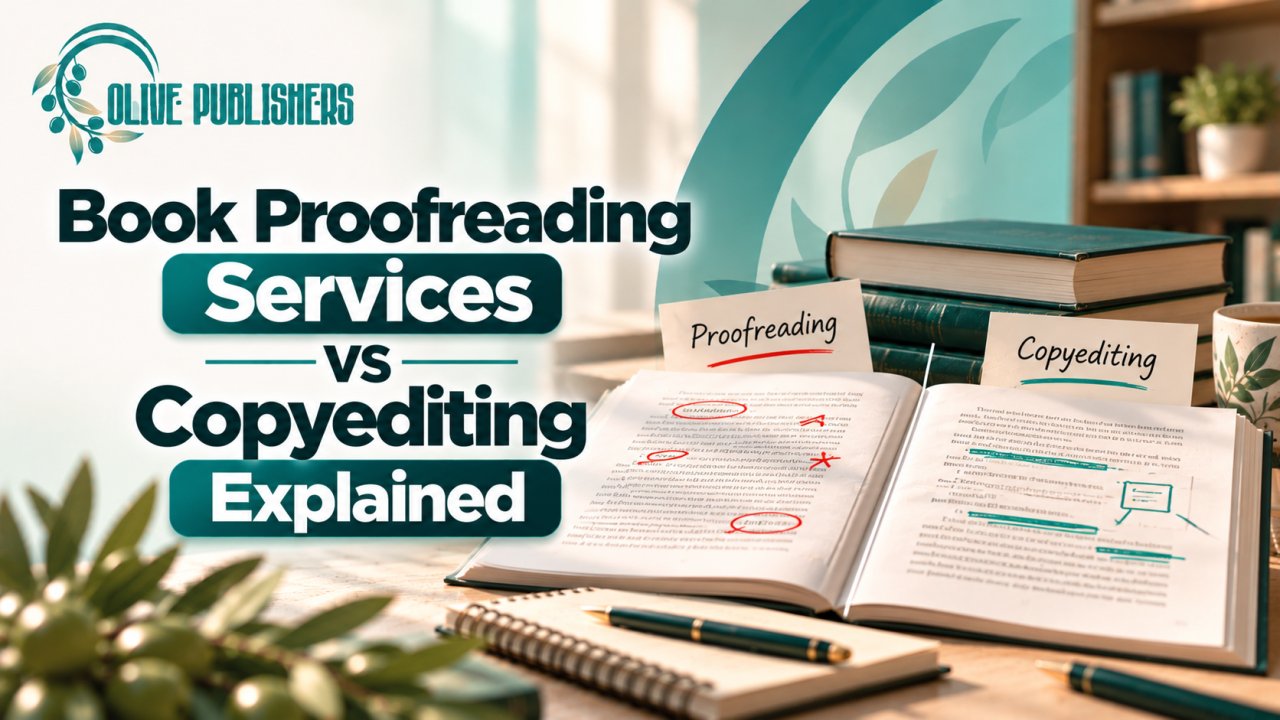
Book proofreading services and copyediting both help authors prepare a manuscript for publication, but they serve different purposes. Copyediting improves grammar, punctuation, spelling, consistency, and sentence-level clarity before the final layout. Proofreading is the final quality check that identifies remaining errors in the formatted book before publication.
Choosing the right service depends on your manuscript's current condition, the type of editing it has already received, and whether the book has been formatted. An author with inconsistent terminology and grammatical errors may need copyediting, while a book that has already been edited and designed may be ready for proofreading.
Understanding the difference can help you select the right service, avoid unnecessary revisions, and prepare a more professional reading experience. Olive Publishers offers book editing services and book proofreading services for authors who need support at different stages of the publishing process.
Quick Answer
Copyediting reviews the manuscript before final layout to improve language accuracy, consistency, and readability. Proofreading reviews the near-final formatted pages to catch remaining mistakes, including typographical errors and layout issues.
In a typical publishing workflow, editing and proofreading happen in a specific order. Major structural problems should be addressed first, language and consistency should be refined before layout, and the final proof should be checked after formatting.
A proofread is not a substitute for a full copyedit. If the manuscript still needs substantial rewriting, it is usually better to resolve those problems before paying for a final proofread.
What Are Book Proofreading Services?
Book proofreading services provide a final review of a manuscript after the main editing work and usually after the book has been formatted. The purpose is to identify errors that remain in the version readers will receive.
A proofreader examines the text carefully and checks whether the pages are consistent, readable, and free from avoidable mistakes. The exact scope depends on the agreement, but proofreading generally focuses on corrections rather than extensive rewriting.
What Does Proofreading Include?
A professional proofreading review may cover:
-
Spelling and typographical errors.
-
Incorrect or missing punctuation.
-
Grammar mistakes that remain after editing.
-
Inconsistent capitalization and hyphenation.
-
Repeated or missing words.
-
Incorrect chapter headings and numbering.
-
Inconsistent page headers and footers.
-
Extra spaces and awkward line breaks.
-
Formatting inconsistencies in the final document.
-
Obvious discrepancies in names, dates, and terminology.
Proofreading can also identify problems introduced during typesetting or document conversion. For example, a chapter heading may appear incorrectly formatted, a paragraph may have an unusual spacing issue, or a page number may be missing.
The proofreader should document corrections clearly so the author or production team can review and apply them.
When Should You Hire a Proofreader?
Proofreading is generally appropriate when the manuscript has already received the necessary editing and the layout is close to final.
Consider proofreading when:
-
Your book has been copyedited.
-
The text has been formatted for print or digital publication.
-
You need a final check before releasing the book.
-
Previous corrections have been applied.
-
You want to identify mistakes that may have been overlooked during production.
If substantial rewriting is still necessary, address it before the final proofread. Significant changes made afterward can introduce new errors and may require another review.
What Is Copyediting?
Copyediting is a detailed review of the manuscript's language and consistency. It helps ensure that the writing follows appropriate grammar, spelling, punctuation, and style conventions while preserving the author's intended meaning and voice.
Unlike proofreading, copyediting takes place before the final book layout in a typical publishing workflow. It gives the author an opportunity to resolve language problems before the manuscript moves into production.
What Does Copyediting Include?
Depending on the agreed scope, copyediting may include:
-
Correcting grammar, spelling, and punctuation.
-
Improving sentence-level clarity.
-
Checking capitalization and word usage.
-
Standardizing names, dates, terminology, and abbreviations.
-
Identifying repeated words and inconsistent expressions.
-
Checking continuity details within the manuscript.
-
Applying a consistent editorial style.
-
Flagging unclear passages for the author.
-
Identifying factual inconsistencies that require author verification.
-
Reviewing headings and text organization for consistency.
Copyediting does not automatically include developmental editing, extensive rewriting, fact-checking of every claim, or research verification. Those tasks should be discussed separately when needed.
When Should You Hire a Copyeditor?
Copyediting is usually the right choice when the manuscript is substantially complete but needs a detailed language review.
You may benefit from copyediting if:
-
Grammar and punctuation errors appear throughout the text.
-
Character names, dates, or terminology are inconsistent.
-
Sentences are understandable but need refinement.
-
The manuscript has not received professional language editing.
-
You want to establish consistent spelling and style conventions.
-
The text needs to be prepared for formatting and publication.
Copyediting helps create a more consistent manuscript, but it cannot guarantee that every error will be eliminated. A separate final proofread remains valuable after the book has been laid out.
Book Proofreading Services vs Copyediting: Key Differences
The primary difference is the stage at which the work happens and the type of problems each service is intended to address.
| Feature | Copyediting | Proofreading |
|---|---|---|
| Main purpose | Improve language accuracy and consistency | Catch remaining errors before publication |
| Typical stage | Before final layout | After layout, near publication |
| Main focus | Grammar, punctuation, usage, consistency, and clarity | Typos, missed errors, and layout-related issues |
| Sentence rewriting | Limited clarification may be included in scope | Usually limited to minor corrections |
| Formatting review | Checks relevant consistency in the manuscript | Checks the formatted pages |
| Author interaction | May involve tracked changes and editorial queries | Usually involves a correction list or annotations |
| Best suited for | Manuscripts that need detailed language review | Books that have already been edited and formatted |
Both services improve the reading experience, but they are not interchangeable. Copyediting addresses the quality of the manuscript text, while proofreading checks the final version presented to readers.
The 4 Main Stages of Book Editing
Authors sometimes use the terms editing and proofreading interchangeably. However, publishing commonly involves four distinct stages, each with a different objective.
1. Developmental Editing
Developmental editing examines the manuscript's overall structure and content. It addresses large-scale questions about organization, pacing, completeness, argument, and audience.
For fiction, this may involve character development, plot progression, scene order, and narrative consistency. For nonfiction, it may involve the strength of the argument, chapter organization, missing explanations, and the sequence of ideas.
Developmental editing is appropriate when the manuscript needs substantial changes before detailed language editing begins.
2. Line Editing
Line editing focuses on how the writing communicates its ideas. It examines sentence flow, tone, word choice, rhythm, transitions, and style.
For example, a paragraph may be grammatically correct but difficult to follow because it contains too many ideas. A line editor may suggest a clearer construction while preserving the author's intended meaning and voice.
Line editing is especially useful when a manuscript needs stylistic refinement rather than basic correction alone.
3. Copyediting
Copyediting focuses on correctness and consistency at the sentence and manuscript levels. The editor checks language conventions, usage, punctuation, spelling, terminology, and continuity.
The goal is to prepare a consistent manuscript before final formatting. Any substantial changes to meaning should be discussed with the author rather than introduced without approval.
4. Proofreading
Proofreading is the final review of the formatted book. It checks for remaining text errors and problems that may have appeared during layout.
The proofreader may identify a misspelled word, inconsistent heading, missing punctuation mark, or unexpected spacing issue. Corrections are then applied before the final files are approved.
These four stages do not necessarily mean that every book needs four separate services. The appropriate sequence depends on the manuscript's condition and the author's publishing goals.
How to Decide Which Editing Service Your Book Needs
Before hiring an editor, evaluate the manuscript's current state. Choosing a service based on the actual problem is more useful than selecting the option with the broadest description.
Choose Developmental Editing if the Structure Needs Work
If the story has plot gaps, the chapters feel disorganized, or the argument is difficult to follow, start by addressing the manuscript's structure.
Correcting grammar will not resolve a missing chapter or a weak argument. Structural issues should be resolved before detailed language editing whenever possible.
Choose Line Editing if the Writing Needs Refinement
If the content and structure are sound but the sentences feel awkward, repetitive, or difficult to read, line editing may be appropriate.
This service concentrates on expression, clarity, and flow while retaining the author's voice.
Choose Copyediting if the Text Needs Consistency
If the manuscript is complete but contains inconsistent terminology, grammar problems, punctuation mistakes, or unclear sentences, copyediting is a likely fit.
The editor should agree on the expected level of intervention before beginning.
Choose Proofreading if the Book Is Nearly Ready
If the manuscript has already been edited and formatted, proofreading is generally the appropriate final step.
The purpose is to identify remaining mistakes in the actual publication files rather than reopen the entire editorial process.
Fiction and Nonfiction Require Different Editing Checks
The basic distinction between copyediting and proofreading remains the same across genres, but the details of the review can differ.
Editing Fiction Books
Fiction editors often need to check continuity, character development, dialogue, narrative perspective, and timeline details.
Copyediting may identify a character whose name changes unexpectedly or a scene in which the tense shifts without a clear reason. Proofreading can catch remaining punctuation errors, inconsistent character names, or formatting problems in dialogue.
The editor should preserve the author's style and avoid changing creative choices without a clear reason or author approval.
Editing Nonfiction Books
Nonfiction manuscripts may require additional attention to terminology, chapter headings, tables, references, citations, dates, and factual claims.
Copyediting can identify an inconsistent term or a statement that requires clarification. However, verifying every factual claim may require a separate fact-checking process, particularly for technical, historical, scientific, or specialized subjects.
Proofreading checks the final pages for remaining text and layout issues. It should not be treated as a replacement for research verification.
Editing Memoirs and Personal Narratives
Memoirs require careful attention to chronology, names, locations, and the consistency of personal accounts.
Editors should preserve the author's intended meaning and flag unclear or conflicting details rather than inventing explanations. Sensitive passages may require especially careful communication between the author and editor.
The right approach balances clarity with respect for the author's voice and experience.
What Authors Should Send to an Editor
Preparing the right materials helps an editor understand the project and reduces avoidable delays.
Before the project begins, provide:
-
The latest manuscript: Make sure the editor receives the current version rather than an outdated draft.
-
Genre and audience: Explain who the book is intended for and what readers should gain from it.
-
Editing requirements: Describe known issues and whether you need a light or intensive review.
-
Style preferences: Share your preferred spelling conventions, style guide, or formatting requirements when applicable.
-
Reference materials: Provide source notes, terminology lists, character lists, or timelines when they are relevant.
-
Publication plans: Explain whether the book is intended for print, ebook, or multiple formats.
-
Project expectations: Agree on deadlines, deliverables, revision rounds, communication, and approval responsibilities.
For nonfiction, supporting research and citation information may be essential. For fiction, a character list or timeline can help the editor identify inconsistencies.
The more clearly the requirements are documented, the easier it becomes to evaluate the work against the agreed scope.
How Tracked Changes and Editorial Queries Help
Tracked changes allow authors to review proposed edits and decide whether to accept or reject them. They are particularly useful during copyediting because the author can see how language has been corrected or clarified.
Editorial queries identify questions that require the author's input. An editor might ask for clarification when a sentence has more than one possible meaning or when two passages contain conflicting information.
Authors should review these queries carefully. Accepting every change without understanding it can introduce errors if an editor has misunderstood the intended meaning.
A practical workflow is to review each query, provide a clear response, and preserve a record of important decisions. The author should also confirm which file represents the approved manuscript.
Proofreading may use tracked changes, PDF annotations, or a correction list, depending on the production workflow. The important requirement is that corrections can be applied accurately to the final publication files.
Why a Final Proofread Still Matters After Copyediting
Even a careful copyedit does not guarantee that the formatted book will be error-free.
The layout process can introduce new issues, and small errors may remain unnoticed when an author and editor have reviewed the manuscript repeatedly. A final proofread provides a fresh review of the version intended for readers.
For example, an author may approve a correctly edited manuscript, but a formatting change could cause an unusual line break, inconsistent heading style, or missing element in the final file. These issues should be identified before publication.
A final proofread should take place after the layout is sufficiently stable. If substantial text changes are made after the proofread, the affected sections should be checked again.
This is particularly important for print books, where correcting a released edition may require additional production work.
How to Evaluate Book Editing and Proofreading Services
Choosing an editing provider involves more than comparing prices. Authors should understand what the service includes and how the completed work will be evaluated.
Review the Scope of Work
Ask whether the service includes developmental editing, line editing, copyediting, proofreading, or a combination of stages.
The provider should explain what will be reviewed, what will be excluded, and how additional work will be handled.
Request a Relevant Sample
A sample can help you understand how an editor handles your genre, sentence structure, terminology, and author voice.
Use the sample to assess the quality of the work and the clarity of the feedback rather than relying solely on promotional claims.
Confirm Deliverables and Revisions
Clarify whether you will receive a tracked manuscript, clean copy, editorial report, annotated proof, or another agreed deliverable.
Ask how queries will be handled, how many revision rounds are included, and what happens if substantial issues are discovered outside the original scope.
Compare the Total Cost
A lower initial price may exclude tasks that you later need. A higher quote may include additional work, but the difference should be explained clearly.
Compare the scope, communication, turnaround expectations, revision terms, and any additional fees before deciding.
Establish a Clear Approval Process
Agree on who reviews changes, who makes final decisions, and how the approved manuscript will be transferred to formatting or publication.
Written approvals and version control help reduce confusion when multiple people are involved.
No editing service can guarantee a completely error-free manuscript or a specific commercial outcome. The purpose of a professional process is to improve quality, reduce avoidable mistakes, and establish realistic expectations.
Common Editing Mistakes Authors Should Avoid
Several avoidable mistakes can create extra costs or delay publication.
-
Hiring a proofreader too early: If the manuscript still needs extensive rewriting, a final proofread may not address the underlying problems.
-
Skipping copyediting: A formatted book may look professional while still containing inconsistent language and grammar errors.
-
Expecting proofreading to include rewriting: Major structural and stylistic changes usually belong in earlier editing stages.
-
Sending outdated drafts: Multiple versions can cause confusion and lead to corrections being applied to the wrong file.
-
Ignoring editorial queries: Unresolved questions can leave factual inconsistencies or unclear passages in the manuscript.
-
Making substantial late changes: Revisions after proofreading can introduce new errors that need another check.
-
Choosing on price alone: The cheapest option may not cover the work the manuscript actually needs.
-
Failing to confirm ownership and scope: Unclear agreements about deliverables, rights, and revisions can create avoidable disputes.
A short checklist and a clearly defined workflow can help authors prevent these problems before publication.
How Olive Publishers Can Support Your Book
Olive Publishers offers book editing and proofreading support for authors preparing manuscripts for publication. The appropriate service depends on the manuscript's current stage, the amount of work required, and the author's publishing plans.
Authors can explore book editing services to discuss language, clarity, and consistency needs, or review book proofreading services when the manuscript is approaching its final publication stage.
If formatting is also required, the book editing and formatting service provides another relevant starting point for discussing the production requirements.
Before committing, explain what has already been completed and what remains. Ask for a written scope that identifies the deliverables, expected timeline, revision arrangements, and approval process.
The objective is to select support that fits the book rather than purchase unnecessary stages. A clear conversation at the beginning helps establish expectations and keeps the project focused on producing a polished manuscript that retains the author's voice.
To discuss your manuscript and next steps, contact Olive Publishers.
Frequently Asked Questions
What is the difference between book proofreading services and copyediting?
Copyediting improves grammar, punctuation, usage, consistency, and sentence-level clarity before final layout. Book proofreading services provide a final review of the formatted pages to catch remaining errors and layout-related problems. Both stages can be valuable because they address different aspects of publication quality.
Should I hire a copyeditor or proofreader first?
Copyediting generally comes first if the manuscript still needs detailed language correction. Proofreading follows after the editing has been completed and the book has been formatted. If the manuscript has substantial structural problems, developmental editing may be needed before either service.
Does proofreading include rewriting sentences?
Proofreading usually focuses on small corrections and final quality checks rather than extensive rewriting. A proofreader may flag an unclear passage, but significant sentence restructuring generally belongs in an earlier editing stage. Confirm the scope with your provider before work begins.
What are the four main stages of book editing?
The four commonly recognized stages are developmental editing, line editing, copyediting, and proofreading. Developmental editing addresses structure, line editing refines expression, copyediting improves language accuracy and consistency, and proofreading checks the near-final formatted book. Not every manuscript requires all four stages.
Can I proofread my own book?
Authors can catch many mistakes by reviewing the manuscript carefully, changing the viewing format, and using a checklist. However, familiarity with the text can make errors difficult to notice. An independent proofreader provides a fresh perspective before publication.
How much does book proofreading cost?
The cost depends on factors such as manuscript length, complexity, condition, turnaround expectations, and the agreed scope. A manuscript requiring a light final check may need a different level of work from one containing extensive inconsistencies. Request a quote based on the actual manuscript and confirm what is included.
How long does proofreading take?
The timeline depends on word count, formatting complexity, the quality of the manuscript, and the provider's workload. A clear manuscript may require less review than a complex book with extensive references, tables, or specialized terminology. Agree on a realistic deadline before the project begins.
Do fiction and nonfiction books need different editing?
Yes. Fiction often requires attention to characters, dialogue, tense, point of view, and continuity. Nonfiction may require additional checks for terminology, references, citations, tables, and factual claims. The editing plan should reflect the genre and the needs of the intended reader.
What should I send to a professional book editor?
Send the latest manuscript, the book's genre, the intended audience, any known concerns, and your preferred style conventions. Provide supporting references, source notes, character lists, or timelines where relevant. Also explain the planned publication format and the level of editing you need.
Can copyediting and proofreading be combined?
Some providers offer combined packages, but the work should still be performed at the appropriate stages. Copyediting should address the manuscript before final layout, while proofreading should review the formatted version. Ask the provider to clarify the sequence, deliverables, and whether a separate final proofread is included.
Is proofreading necessary after professional copyediting?
A final proofread is often worthwhile because formatting and production can introduce new errors, and some mistakes may remain after editing. The level of review depends on the manuscript and production process. If substantial changes occur after proofreading, the affected pages should be reviewed again.
Conclusion
Book proofreading services and copyediting play different but complementary roles in preparing a manuscript for publication. Copyediting improves language accuracy and consistency, while proofreading checks the final formatted book for remaining mistakes.
Choosing the right service begins with understanding your manuscript's current condition. Address structural and stylistic problems first, complete the necessary language editing before layout, and arrange a final proofread when the book is nearly ready for publication.
A clear scope, reliable communication, and careful version control help prevent unnecessary revisions and production delays. By matching each editing stage to the book's actual needs, authors can improve the reading experience while protecting their individual voice.
Olive Publishers can help authors explore book editing and proofreading support based on their project requirements. Review the relevant service details and contact the team to discuss your manuscript and the next steps.