On this page (32)
- What Self Publishing Companies Actually Do
- How to compare self publishing companies
- Book publishing companies versus self publishers
- Self publishing websites and self publishing platforms
- Book publishing companies near me VS online providers
- What to look for in a publishing package
- Costs and value
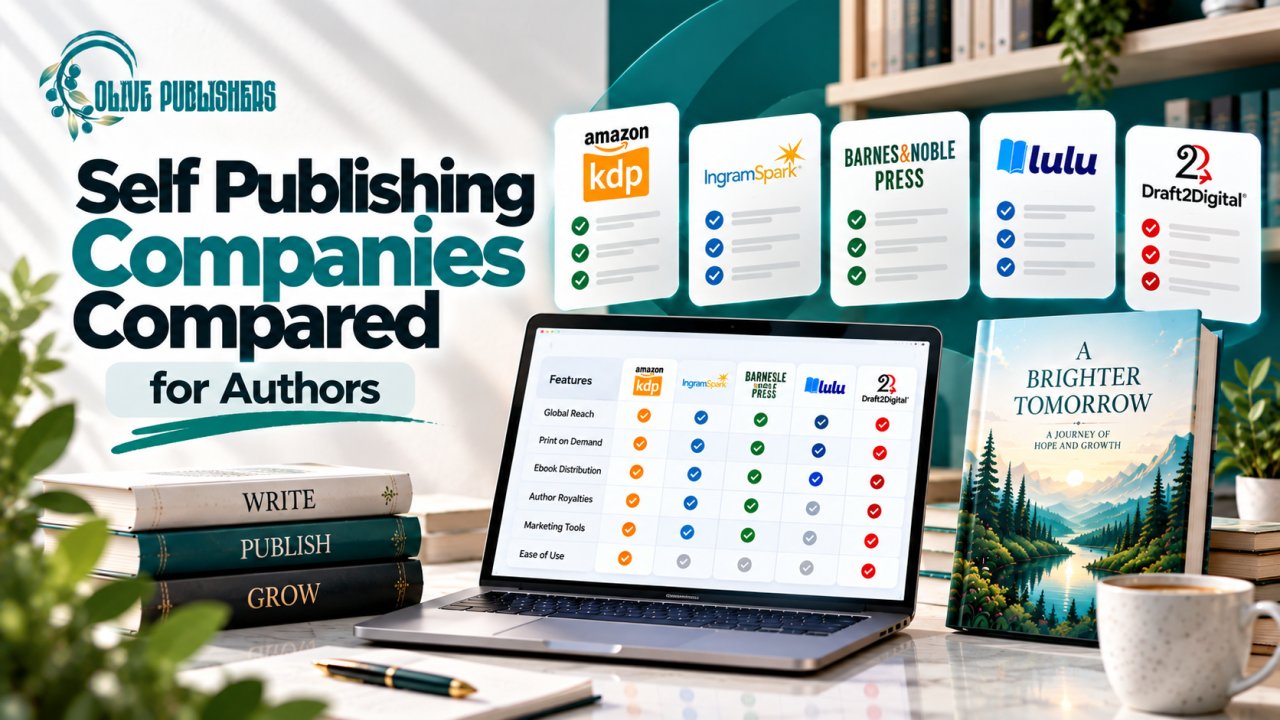
- Self publishing companies compared
- Questions to ask before hiring
- What first time authors should do
- How to evaluate marketing support
- Why Olive Publishers may be a fit
- Common concerns
- Frequently Asked Questions
- What are self publishing companies
- What is the difference between a book publisher and a self publishing company
- Are self publishing companies worth it
- What should I ask a self publishing company
- Can a self publishing company guarantee sales
- Are online book publishers reliable
- What are self publishing platforms
- Should a first time author hire a publishing company
- Final checklist
- SEO Publishing Details
- A practical evaluation process
- Ownership and control deserve special attention
- A useful way to compare proposals
- How discoverability affects the decision
- A deeper look at service quality
- How distribution should be discussed
- Practical decision checklist
- Thinking beyond the first book
Self publishing companies is an important search for authors deciding how to publish, what support to hire and how much control to keep. This guide explains the options in plain language so you can compare providers without relying on sales claims alone.
Quick Answer
· The best self publishing company is the one that matches your manuscript, budget, publishing goals, ownership needs and level of support.
· Compare editing, cover design, formatting, distribution, metadata, marketing, revisions, communication and contract terms instead of comparing package names alone.
· A low price can be useful, but the cheapest option is not always the lowest total cost if weak production creates rework later.
· First time authors should ask for a clear scope, timeline, deliverables, rights information and examples of relevant work before committing.
What Self Publishing Companies Actually Do
Self publishing companies provide services that help an author move from a finished manuscript to a professionally produced and distributed book. Some providers focus on one stage such as editing or cover design. Others coordinate several stages through a managed publishing service.
The distinction matters because self publishing itself does not require a traditional publisher. An author can publish independently through a platform and hire separate specialists. A service company can instead coordinate production while the author keeps responsibility for the book and publishing decisions.
The market is crowded. Publishers Weekly reported that more than 4 million ISBN registered books were published in the United States in 2025. More than 3.5 million were self published, a 38.7 percent increase from 2024. That volume makes professional positioning and discoverability increasingly important. citeturn0search0
How to compare self publishing companies
How to compare self publishing companies starts with the work you actually need. A provider that is excellent at editing may not be the right choice if your main need is distribution and launch marketing. Start by listing your gaps.
|
Area |
What to compare |
Questions to ask |
Why it matters |
|
Editing |
Developmental, copyediting and proofreading |
Which level is included |
Editorial quality affects reader trust |
|
Design |
Cover and interior layout |
Who owns final files |
Design affects presentation |
|
Publishing |
ISBN, metadata and platform setup |
Which accounts are used |
Setup choices affect control |
|
Distribution |
Retail, ebook and print availability |
Which territories and formats |
Distribution determines access |
|
Marketing |
Amazon, SEO, social, email, reviews and outreach |
What is actually delivered |
Visibility needs ongoing work |
|
Support |
Communication, revisions and reporting |
Who handles questions |
Good coordination reduces delays |
Book publishing companies versus self publishers
Book publishing companies can mean very different business models. A traditional publisher generally acquires rights and takes responsibility for publishing under its own model. A self publishing service company usually provides paid production or marketing support while the author remains responsible for the publishing project.
If a company uses the word publisher, ask what that means in the contract. Find out who owns the ISBN, who controls retailer accounts, who owns source files, how royalties are handled and whether you can move the book elsewhere later.
Self publishing websites and self publishing platforms
Self publishing websites and self publishing platforms are not the same thing as service companies. A platform may let you upload a book yourself. A service company may prepare the files, metadata or marketing plan for you. Some businesses combine both roles.
Choose the model that matches your time and skill. An experienced author with production knowledge may prefer direct platform control. A first time author may prefer professional help for editing, design, formatting or marketing while keeping important account access and rights.
Book publishing companies near me VS online providers
Book publishing companies near me can be useful when you want local meetings or a local production partner. Online providers can be equally practical when communication, file review, project management and support are handled well.
Location should not be the only filter. A nearby provider with weak communication is not automatically better than a remote team with a clear workflow. Compare proofing, response time, deliverables and ownership terms.
What to look for in a publishing package
A useful package should explain the actual work rather than simply listing impressive sounding services. Look for a written scope that names the deliverables.
· Manuscript assessment and the exact editing level included
· Professional cover design with genre appropriate direction
· Interior formatting for the selected print and digital formats
· Metadata preparation including title, description, categories and keywords where applicable
· ISBN guidance and a clear explanation of ownership
· Distribution setup with named platforms or channels
· Proof review before publication
· Marketing services with defined activities and reporting
· Revision limits and approval points
· Final source files and account access terms
Costs and value
Costs vary widely because publishing projects vary widely. A manuscript needing only formatting is very different from a project needing developmental editing, cover design, ebook production, distribution and a marketing campaign.
The Association of American Publishers reported that United States publishing revenue reached 1.0 billion dollars in July 2026, up 14.0 percent year over year. Trade consumer book revenue was 804.1 million dollars, up 16.4 percent. These figures show a healthy commercial market, but they do not mean every individual book will sell well. citeturn0search3
Ask for the total project cost and the cost of optional services. Also ask what happens if revisions take longer than expected. The right comparison is total value for the work you actually need.
Self publishing companies compared
A simple comparison can help you decide which type of provider fits your project.
|
Provider type |
Best for |
Main advantage |
Watch for |
|
DIY platform |
Authors who want maximum control |
Low setup cost and direct control |
You handle production and marketing |
|
Specialist freelancer |
One specific need |
Focused expertise |
You coordinate multiple people |
|
Full service company |
Authors wanting coordinated support |
One workflow across stages |
Review scope and ownership carefully |
|
Traditional publisher |
Authors seeking an acquisition model |
Publisher led production and distribution |
Selection is competitive and rights terms vary |
Questions to ask before hiring
· What exactly is included in the quoted price
· Who owns the ISBN and publishing accounts
· Will I receive editable source files
· How many revision rounds are included
· Who approves the final cover and interior
· Which formats will be produced
· Which distribution channels will be used
· How is marketing measured
· Will I receive campaign or sales reporting
· What happens if I decide to stop using the company
What first time authors should do
First time authors should avoid choosing a provider only because a package sounds large. Start with the manuscript, audience, format and publishing goal. Then identify the stages where you need professional help.
· Finish or assess the manuscript
· Identify the intended reader
· Choose the main formats
· Set a realistic budget
· Request two or three detailed proposals
· Compare ownership and account access
· Review relevant samples
· Ask how final approvals work
· Plan marketing before publication
How to evaluate marketing support
Marketing support should connect the book to the right audience instead of simply producing a large number of posts. Depending on the book, useful services can include Amazon Marketing, Search Engine Optimization, Social Media Marketing, Content Marketing, email marketing, Influencer Marketing, book reviews, PR outreach, Meta Ads and Book Launch Marketing.
Track useful signals such as retailer conversion, Amazon BSR movement, advertising CTR, CPC and ACOS, email growth and qualified website traffic. Do not treat impressions or follower counts as the entire result.
Why Olive Publishers may be a fit
Olive Publishers describes its services as covering writing, editing, formatting, publishing, design and marketing. Its publishing page also describes self publishing support that includes manuscript formatting, cover design, marketing and distribution. citeturn0search1turn0search2
You can review the company's book publishing services to see how its publishing workflow is structured.
If you need a broader project discussion, use the Olive Publishers contact page.
The practical reason to consider a full service workflow is coordination. When editing, design, formatting, publishing and marketing are planned together, decisions made early can support later discovery and promotion.
Common concerns
Some authors worry that using a service company means losing control. That is not automatically true. The contract should explain ownership, account access, approvals and final files.
Others worry that professional support will always be expensive. The better question is whether the service removes a bottleneck that would otherwise cost you time, quality or repeated work.
Frequently Asked Questions
What are self publishing companies
Self publishing companies are businesses that provide publishing related services to authors who are independently publishing their books. Services can include editing, design, formatting, distribution and marketing.
What is the difference between a book publisher and a self publishing company
A traditional book publisher usually acquires and publishes books under its own publishing model. A self publishing company generally provides paid services while the author remains responsible for the independent publishing project.
Are self publishing companies worth it
They can be worth it when professional support solves a real production or marketing problem. Compare the scope, ownership, quality, communication and total cost before deciding.
What should I ask a self publishing company
Ask about deliverables, revisions, ownership, ISBNs, account access, distribution, source files, timeline, marketing activities and reporting.
Can a self publishing company guarantee sales
No responsible provider can guarantee a specific sales result. Marketing can create opportunities for discovery and conversion but results depend on the book, audience, market and execution.
Are online book publishers reliable
Some are, but reliability should be evaluated through transparent scope, relevant samples, clear contracts, communication and ownership terms.
What are self publishing platforms
Self publishing platforms are services that let authors upload and distribute books directly. They are different from companies that provide managed publishing services.
Should a first time author hire a publishing company
A first time author may benefit from professional help when the project includes editing, design, formatting, distribution or marketing tasks they cannot confidently manage alone.
Final checklist
· Clear manuscript and reader
· Defined publishing goal
· Detailed proposal
· Ownership terms reviewed
· ISBN plan understood
· Formats confirmed
· Distribution confirmed
· Proofing process confirmed
· Marketing scope documented
· Reporting expectations documented
· Final files and account access understood
SEO Publishing Details
SEO Title Self Publishing Companies Compared for Authors
Meta Description Compare self publishing companies for authors by services, ownership, pricing, production quality, distribution and marketing support.
Suggested URL /blogs/Compare self publishing companies for authors by services, ownership, pricing, production quality, distribution and marketing support.
Primary Keyword self publishing companies
Secondary Keywords book publishing, book publishing companies, book publisher, online publishing, book publishing company, self publishing websites, self publishers, self publishing platforms
Search Intent Commercial
Suggested Schema Article, FAQPage and BreadcrumbList when breadcrumb navigation is visible
Suggested Image Alt Text
· self publishing companies comparison for authors
· author comparing self publishing company services
· book publishing company evaluation checklist
Cross Linking Suggestions
· Self Publishing Guide for First Time Authors
· Self publishing packages and what they include
· How to choose a book publishing company
Research and editorial note Industry figures in this guide use current 2025 and 2026 publishing data from the Association of American Publishers and Bowker data reported by Publishers Weekly. Company service descriptions are based on Olive Publishers published website information. No ranking, sales or bestseller outcome is guaranteed.
A practical evaluation process
Start by writing down the exact outcome you want. You may want a finished paperback, an ebook, worldwide distribution, help with marketing or simply expert review of a manuscript. The more precise the goal, the easier it becomes to compare self publishing companies.
Next ask each provider to explain the workflow in the same order. A useful workflow normally moves from manuscript review to editing, design, formatting, proofing, metadata, publishing, distribution and promotion. When a company cannot explain where your project fits, ask more questions before making a decision.
Finally compare what happens after publication. A book can be technically live while still receiving very little reader attention. Find out whether the provider offers post launch support, marketing analysis, retailer optimization or backlist promotion.
· Request a written project scope
· Ask for named deliverables rather than broad promises
· Confirm who approves every major production decision
· Keep copies of the final manuscript and production files
· Ask how changes are handled after publication
Ownership and control deserve special attention
Ownership is one of the most important differences between publishing models. Before signing, understand who owns the copyright, who owns the ISBN, who controls retailer accounts and whether you can access the original files.
Account control matters because a book may remain available for years. If a provider creates an account that you cannot access, moving the title later can become difficult. A clear agreement should explain access and responsibility.
Rights should also be explained in plain language. If a service includes distribution, marketing or audiobook production, ask whether those services create any separate rights obligations.
· Confirm copyright ownership
· Confirm ISBN ownership
· Confirm retailer account access
· Confirm final source file delivery
· Read termination and transfer terms
A useful way to compare proposals
When proposals look different, translate them into the same checklist. For example, one company may advertise a large package while another lists smaller services separately. The package size alone does not tell you which option is better.
Compare the amount of editorial attention, design work, formatting work, publishing setup, distribution support and marketing execution. Also compare the amount of author involvement required. A lower invoice can require much more of your time.
Look for evidence of process. A provider should be able to explain how manuscripts are reviewed, how design is approved, how proofing happens and how publication errors are handled.
· Compare total work
· Compare author workload
· Compare revision terms
· Compare communication
· Compare reporting
How discoverability affects the decision
Discoverability should be part of the publishing conversation from the beginning. Accurate metadata, strong category choices, a clear book description and a genre appropriate cover help retailers and readers understand the book.
Marketing should then extend that foundation. Search Engine Optimization can support organic discovery. Social Media Marketing can build awareness. Email marketing can support repeat communication. Book reviews and relevant PR outreach can add credibility. Amazon Marketing can help test retailer demand.
Do not judge a provider by the number of promotional activities alone. Ask what audience each activity is intended to reach and how performance will be evaluated.
· Define the target reader
· Create a clear positioning statement
· Prepare accurate metadata
· Build a launch plan before publication
· Continue promotion after launch
A deeper look at service quality
Service quality is easier to judge when you look at the process instead of the sales page. Ask how manuscripts are assigned, who reviews the work, how authors give feedback and how corrections are tracked.
Relevant experience matters too. A provider working on a children's picture book needs different production knowledge from a provider working on a business book. Ask to see work that is close to your format and genre.
Also look at consistency. A beautiful sample is useful, but your project will pass through several stages. The real question is whether the company has a repeatable process that can carry the book from manuscript to finished edition.
· Review relevant samples
· Ask who performs each stage
· Confirm the approval process
· Ask how corrections are tracked
· Check whether the workflow fits your genre
How distribution should be discussed
Distribution is often presented as a long list of retailers. A better comparison asks where your book will actually be available, in which formats and territories and under whose accounts.
An author should understand the difference between availability and discoverability. Distribution can make a book available for purchase, but it does not automatically create reader demand.
Ask whether the provider helps with metadata and retailer setup. Accurate information can make the book easier for retailers and readers to understand.
· Ask which formats are distributed
· Ask which territories are covered
· Ask who controls the accounts
· Ask how metadata is submitted
· Ask what support exists after publication
Practical decision checklist
Use the same questions for every provider so the comparison remains fair.
Ask for a project timeline that identifies major approval points.
Keep ownership and account access questions separate from marketing questions.
Do not choose a provider only because it uses the word best in its marketing.
Review the complete proposal before making a payment.
· Clear scope
· Relevant samples
· Written ownership terms
· Defined timeline
· Marketing measurement
· Final file access
Thinking beyond the first book
Authors should also think about the relationship between publishing and future books. A good publishing setup should not create unnecessary barriers when you release another title. Keep your author name, metadata, files and account information organized so the next project can build on the first.
Your publishing partner should also understand that publication is not the finish line. Retail pages may need improvement, advertising may need testing and new content may be needed after launch. A company that can explain this full lifecycle is easier to evaluate than a company focused only on getting the book live.