On this page (27)
- Book Print on Demand Explained
- How to pick the right company for your book
- Quick answer
- Table of contents
- What is book print on demand
- How book print on demand works step by step
- Print on demand versus traditional publishing and offset printing
- The best print on demand book companies compared
- Print on demand for different book types
- Who book print on demand is best suited for and who it is not
- A good fit if you:
- Probably not the right fit if you:
- How to self publish with print on demand, a beginner walkthrough
- Book print on demand costs and royalties explained
- Marketing your print on demand book
- KPIs and metrics to track after you publish
- Common mistakes authors make with print on demand books
- Why authors choose Olive Publishers for book print on demand
- Frequently asked questions
- What is a print on demand book, in simple terms
- How much does book print on demand cost to start
- Can I self publish print on demand without any experience
- Is print on demand good for hardcover books
- What is the difference between print on demand and self publishing
- Which print on demand book company pays the best royalties
- Do I need an ISBN for a print on demand book
- Getting your book into print does not have to be complicated
Book Print on Demand Explained
How to pick the right company for your book
Book print on demand lets you publish a book, get it professionally printed and sell copies without paying for a warehouse full of stock upfront. If you have ever typed "book print on demand" into Google trying to figure out how it actually works, whether it costs anything, or which company to trust with your manuscript, this guide covers the whole picture in one place.
Quick answer
Book print on demand is a printing and distribution model where each copy of your book is printed only after someone orders it. There is no upfront print run, no warehouse, and no unsold inventory sitting in a garage.
-
Authors pay little to nothing upfront to get a book listed
-
Copies are printed one at a time as orders come in through Amazon, a store, or a website
-
Royalties are paid per sale, usually 40% to 60% for direct sales depending on the platform
-
Works for paperback, hardcover, workbooks, and booklets alike
-
Best paired with a real marketing plan since printing availability alone does not create sales
Table of contents
- What is book print on demand
- How book print on demand works step by step
- Print on demand versus traditional publishing
- The best print on demand book companies compared
- Print on demand for different book types
- Who this is for and who it is not
- How to self publish with print on demand
- Book print on demand costs and royalties
- Marketing your print on demand book
- KPIs to track after you publish
- Common mistakes authors make
- Why authors choose Olive Publishers
- Frequently asked questions
What is book print on demand
Book print on demand is a production model where a physical copy of your book only gets manufactured once a customer places an order. Rather than a publisher printing 3,000 copies and hoping they sell, a print on demand book publisher stores a digital print file, and a machine at a facility prints, binds and ships a single copy within a day or two of the order.
This is different from a print on demand book service in the t-shirt or mug sense. The publishing side of print on demand covers full length paperbacks, hardcovers, workbooks and booklets, produced to the same trim sizes and paper stock readers expect from a bookstore book. The technology behind it, primarily digital offset and inkjet presses, has improved enough over the last decade that most readers cannot tell a print on demand paperback apart from one that came off a traditional print run.
The self publishing market has grown fast enough to make this the default model for new authors. In 2025, the global self publishing market reached $2.16B, expanding at roughly 16.7% a year, more than sixteen times faster than traditional publishing's 1% growth. Over 3.5 million self published titles were issued ISBNs that year in the US alone, and self published titles now outnumber traditionally published books by more than 5 to 1.
How book print on demand works step by step
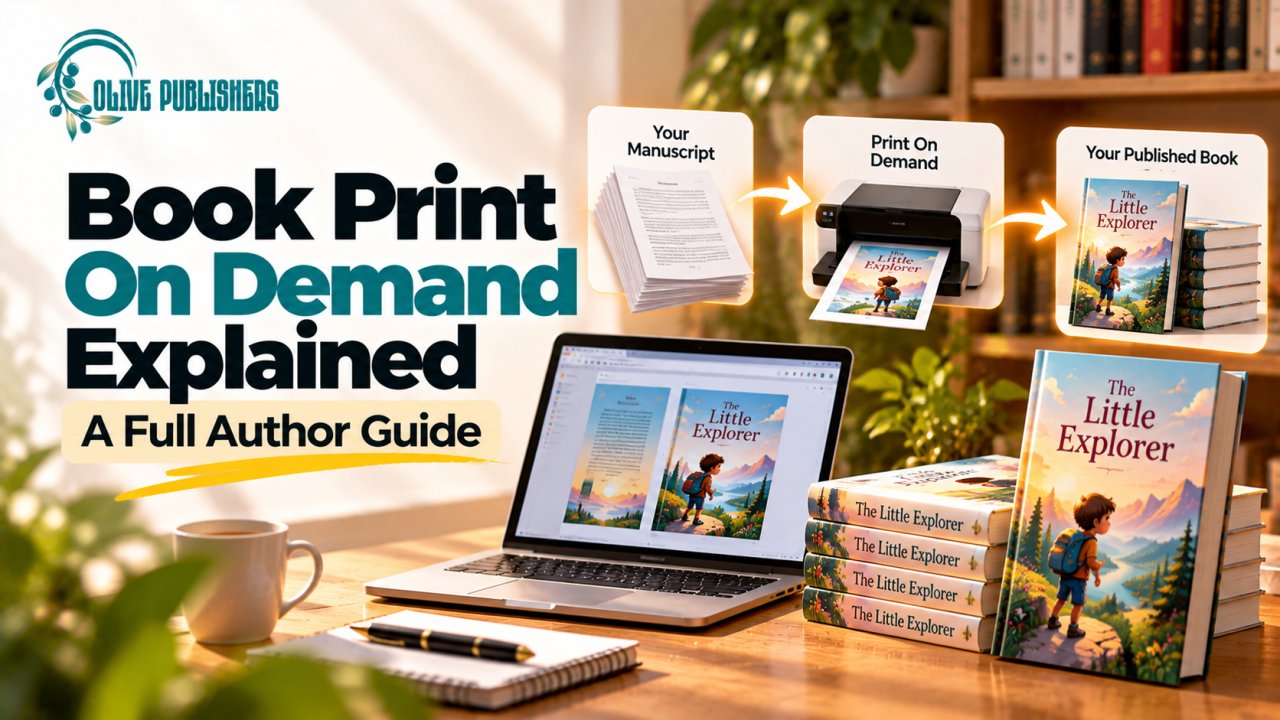
How book print on demand works comes down to four repeatable steps that stay the same whether you use Amazon KDP, IngramSpark, or a full service publisher.
- You upload a print ready file. This is your interior manuscript formatted to a specific trim size and a cover file sized to your page count and paper stock.
- Your book gets listed for sale. Depending on the platform, it appears on Amazon, a dedicated storefront, or through a wholesale catalog that bookstores and libraries can order from.
- A reader places an order. The order triggers a print job at a facility, sometimes located regionally to reduce shipping time and cost.
- The book prints, binds and ships, usually within 24 to 72 hours, and you get paid a royalty once the sale settles.
Nothing is printed and warehoused ahead of demand, which is the entire point of the model. It removes the two biggest risks first time authors face, spending thousands on a print run before knowing if the book will sell and being stuck storing or discounting unsold copies.
Print on demand versus traditional publishing and offset printing
Print on demand differs from traditional offset printing mainly in volume, cost per unit and risk. Offset printing needs a minimum order, often 500 to 1,000 copies, to bring the per unit cost down. Print on demand book printing has no minimum order at all, though the per copy cost is higher.
| Factor | Print on demand | Traditional offset print run | Traditional publishing deal |
|---|---|---|---|
| Upfront cost | Low to none | High (print run + storage) | None to author, but advance is rare for new authors |
| Minimum order | 1 copy | Hundreds to thousands | Determined by publisher |
| Time to market | Days | Weeks to months | 12 to 24 months typically |
| Unsold inventory risk | None | High | None for the author |
| Royalty per copy | Higher, 40% to 60% direct | Higher margin at scale, but only after breakeven | Typically 7% to 15% of list price |
| Creative and pricing control | Full control | Full control | Publisher controls most decisions |
| Best for | New authors testing the market, backlist titles, niche nonfiction | Established authors with proven demand, large events, bulk institutional sales | Authors seeking traditional bookstore placement and an advance |
Neither model is universally better. Authors who already know they can sell 1,000 copies at a launch event benefit from offset economics. Everyone else, especially first time and self published authors, is usually better served starting with print on demand and moving to a larger print run once sales data proves demand.
The best print on demand book companies compared
Print on demand book companies fall into three general categories, retail platforms like Amazon KDP, wholesale distribution networks like IngramSpark, and full service publishers like BookBaby and Olive Publishers that combine printing with editing, design and marketing.
Amazon KDP
Amazon Kindle Direct Publishing is free to use and remains the largest single sales channel for self published authors, with over 6 million active titles on the platform. Paperback and hardcover royalties sit at 50% or 60% of list price depending on where your price falls relative to a marketplace threshold introduced in June 2025 (currently $9.98 in the US), minus the manufacturing cost, which is calculated by page count and trim size. A 300 page black and white paperback typically costs around $3.65 to manufacture, so a book priced at $14.99 nets an author roughly $5 to $5.30 per copy sold directly on Amazon.
IngramSpark
IngramSpark connects your title to Ingram's wholesale catalog, which independent bookstores and libraries actually order from, something Amazon's own expanded distribution rarely achieves in practice. Royalties are lower per copy after Ingram's wholesale discount and market access fee, but the reach into physical bookstores is the tradeoff most serious authors accept.
BookBaby
BookBaby is a well known name in book publishing print on demand, running two tiers around $199 for a standalone Bookshop storefront and $399 to add Amazon distribution, paying a 50% royalty on direct Bookshop sales. It is a solid choice for authors comfortable managing their own marketing, cover files and formatting, since BookBaby's role stops largely at printing, distribution and a self serve storefront rather than hands on publishing guidance.
Full service publishers, including Olive Publishers
A full service print on demand book publisher wraps the printing and distribution layer inside a complete package that also covers manuscript editing, cover design, interior formatting and a marketing strategy built around your specific book category. This matters most for authors who do not want to become their own project manager across five separate vendors.
| Company | Starting cost | Royalty model | What is included beyond printing |
|---|---|---|---|
| Amazon KDP | Free | 50% or 60% direct, minus manufacturing | Listing only, no editing or design |
| IngramSpark | Setup fee, often under $50 | Lower per copy after wholesale discount | Bookstore and library wholesale access |
| BookBaby | Around $199 to $399 | 50% on direct Bookshop sales | Storefront tools, no full editorial team |
| Olive Publishers | Custom by project scope | Author keeps their book's royalty structure | Editing, design, formatting, POD printing and a full marketing plan |
Print on demand for different book types
Print on demand book printing is not limited to standard novels. Workbooks, activity books, journals, booklets and even hardcover gift editions all run through the same on demand process, provided the interior file meets the platform's page count and binding requirements.
Print on demand workbooks with heavy interactive layouts, tables or worksheets need extra attention to interior formatting since print on demand presses handle full bleed images and colored interiors differently than plain text novels. Booklets under a certain page count sometimes fall outside standard print on demand minimums, so check a platform's page count floor (commonly 24 to 32 pages) before committing to a format. Authors selling print on demand books for Etsy or a personal storefront typically need a print partner that supports direct fulfillment to a separate ecommerce platform, which is a feature not every print on demand company offers by default.
Hardcover print on demand has become far more accessible in the last few years. Amazon KDP added a hardcover option, and demand for print on demand hardcover books keeps climbing among memoir and nonfiction authors who want a premium physical product for signings and gifting, even while their day to day retail sales run through the cheaper paperback edition.
Who book print on demand is best suited for and who it is not
Book print on demand works best for first time authors, self published nonfiction writers, niche category fiction authors and anyone who wants to test market demand before committing money to a large print run. It is also a strong fit for backlist titles, older books an author wants to keep available without paying for ongoing storage.
A good fit if you:
- Are publishing your first book and do not yet know how many copies will sell
- Want to keep full creative and pricing control over your book
- Are targeting online retail sales rather than large scale physical bookstore placement
- Write in a niche category where a smaller, steady stream of sales is realistic
Probably not the right fit if you:
- Already have confirmed bulk orders, such as a school district or a corporate buyer, where offset printing brings the per unit cost down meaningfully
- Need books in hand within 24 hours for a specific in person event with no shipping buffer
- Are pursuing a traditional publishing deal with a major imprint, where the publisher controls the printing decision entirely
How to self publish with print on demand, a beginner walkthrough
Self publishing print on demand starts with a finished, edited manuscript, since no print on demand platform will catch structural or line editing issues for you. Once your manuscript is ready, the practical steps are consistent across most platforms.
- Edit and proofread the manuscript. This is the step most first time authors underestimate, and it shows up immediately in reviews if skipped.
- Format the interior file to your chosen trim size, typically 5.5 by 8.5 inches or 6 by 9 inches for most fiction and nonfiction.
- Design a print ready cover, sized precisely to your spine width, which changes based on page count and paper stock.
- Choose your print on demand platform or publisher based on whether you need retail reach, bookstore wholesale access, or full service support.
- Order a proof copy before making the book publicly available, since screen previews rarely catch color or trim issues.
- Set your list price using the platform's royalty calculator so your price actually covers the manufacturing cost with room for a real royalty.
- Publish and build your marketing plan before launch day, not after.
Book print on demand costs and royalties explained
Book print on demand costs come from two places, a platform setup or package fee and a per copy manufacturing cost that gets deducted from every sale before you're paid. Understanding both is the difference between pricing a book profitably and losing money on every copy sold.
Manufacturing cost depends on trim size, page count and whether the interior is black and white or full color. A standard 300 page black and white 6 by 9 paperback runs roughly $3.65 to print through Amazon KDP, while a similar book through IngramSpark or BookBaby lands in a comparable range once their own cost structures are applied. Royalty rates for direct retail sales generally sit between 40% and 60% of list price, with the platform's manufacturing cost subtracted before the author sees a payout. As a real example, at a $14.99 list price with a 60% royalty rate and a $3.65 printing cost, an author nets around $5.34 per direct Amazon sale.
Hardcover printing costs more per unit than paperback, since fixed costs for cover boards and binding run several dollars higher before any per page cost is added, which is why hardcover editions are usually priced $5 to $10 above the paperback edition of the same title.
Marketing your print on demand book
Getting your book printed on demand solves distribution, it does not solve discovery. The authors who actually sell copies treat marketing as its own project with a clear strategy, a defined goal and specific tactics mapped to that goal, moving readers from awareness to engagement and finally to a sale.
Search engine optimization on your author website and Amazon listing helps readers find your book organically through relevant keywords in your title, subtitle, categories and book description, work that compounds for years after a launch rather than fading after a week like paid ads.
Amazon marketing, including Amazon Ads and category and keyword optimization, remains the single highest leverage channel for print on demand books since most self published sales still happen on Amazon. Pairing a well optimized listing with Meta Ads on Facebook and Instagram extends reach to readers who have not searched for your book yet but match your genre's audience profile.
Social media marketing, particularly BookTok on TikTok, has become a genuine sales driver rather than just brand awareness. TikTok's book community was tied to an estimated 59 million print books sold in the US in 2024, generating over $760M in revenue linked directly to social discovery. Influencer marketing through book bloggers and BookTok creators who review and recommend titles in your genre extends that same effect without requiring a paid ad budget.
Content marketing through your own blog, newsletter or YouTube channel builds an audience that owns its relationship with you rather than renting attention from a platform algorithm, which matters even more for post launch and backlist marketing, keeping older titles selling long after the initial release window closes.
Book launch marketing benefits from lining up book reviews and PR outreach ahead of publication date, through NetGalley, Kirkus, Goodreads giveaways and book bloggers, so early reviews are already live when your book becomes available to buy. Email marketing with a genre relevant lead magnet, a free short story or chapter for example, turns casual visitors into a list you can market future titles to directly.
The strongest results come from treating strategy as the starting point, not the ad spend. Define the goal first (awareness, engagement or direct sales), then choose the two or three channels above that actually match that goal instead of trying to run every tactic at once. If building and running that plan feels like more than you want to manage solo, Olive Publishers' book marketing services build this strategy around your specific genre and launch timeline.
KPIs and metrics to track after you publish
Tracking the right numbers tells you whether your print on demand book and its marketing are actually working, rather than guessing based on how busy things feel.
- Amazon Best Sellers Rank (BSR), which reflects real time sales velocity within your category and subcategory
- Click through rate on your Amazon ads and any social or search ad campaigns, showing whether your cover and copy are earning attention
- ACOS (advertising cost of sale), the ratio of ad spend to ad generated revenue, which tells you if paid campaigns are actually profitable
- Email open rate and click rate, a strong signal of how engaged your reader list is ahead of a launch or a backlist promotion
- Review count and average rating velocity, since review volume in the first 30 to 60 days materially affects Amazon's algorithm
- Conversion rate on your book's detail page, the percentage of page visitors who actually buy, which points to whether your description and cover need work
Reviewing these numbers monthly, not just during launch week, is what separates authors who improve their next release from authors who repeat the same mistakes.
Common mistakes authors make with print on demand books
Skipping professional editing is the single most common mistake, since readers notice quality issues immediately and leave reviews reflecting it. Pricing too low to "compete" is a close second, since a price that barely covers the printing cost leaves no real royalty and often signals low perceived value to buyers. Publishing without any marketing plan in place, expecting Amazon's algorithm to surface a brand new title on its own, and neglecting the book's metadata (categories, keywords and description) round out the list of avoidable errors that quietly cap a book's sales potential.
Why authors choose Olive Publishers for book print on demand
Olive Publishers combines print on demand production with the editorial, design and marketing work that platforms like Amazon KDP leave entirely in an author's hands. For first time and self published authors juggling a manuscript, a cover, formatting and a launch plan all at once, having one team handle editing, interior design, cover design, print on demand distribution and a genre specific marketing strategy removes a significant amount of guesswork.
This matters most in two places where authors commonly lose momentum, launch marketing and post launch visibility. Olive Publishers builds a marketing plan around search engine optimization, Amazon marketing, targeted social media and PR outreach before a launch date arrives, rather than starting that work after the book is already live and harder to promote. Authors weighing this level of support against a self managed platform can review current publishing packages and pricing to compare what is included beyond printing alone.
No publisher, including Olive Publishers, can promise a guaranteed bestseller ranking or guaranteed sales figures, and any company claiming otherwise deserves scrutiny. What a full service partner can reasonably promise is a professionally produced book, a coordinated marketing plan and print on demand distribution set up correctly from day one, which meaningfully improves the odds compared to publishing alone with no editorial or marketing support. Authors with questions about which package fits their manuscript's stage can reach the team directly through Olive Publishers' contact page.
Frequently asked questions
What is print on demand books
Print on demand books are printed one copy at a time after a customer places an order, rather than manufactured in a large batch ahead of sales. This removes upfront printing costs and eliminates unsold inventory risk for the author or publisher.
What is a print on demand book, in simple terms
A print on demand book is any title where the physical copy does not exist until someone buys it. The file sits ready at a printing facility, and each order triggers a single print, bind and ship cycle, usually completed within a few days.
How much does book print on demand cost to start
Amazon KDP is free to publish through, while full service print on demand book publishers range from roughly $199 for a basic storefront package up to custom pricing for a complete editing, design and marketing package. Per copy manufacturing costs, typically $3 to $5 for a standard paperback, are deducted from each sale rather than charged upfront.
Can I self publish print on demand without any experience
Yes. Self publishing print on demand does not require design or technical experience if you use a platform's templates or work with a full service publisher that handles formatting and cover design on your behalf. The main prerequisite is a finished, professionally edited manuscript.
Is print on demand good for hardcover books
Yes, print on demand hardcover books are widely available now through Amazon KDP, IngramSpark and most full service publishers. Hardcover printing costs more per unit than paperback due to binding and cover board costs, which is why hardcover list prices typically run $5 to $10 higher.
What is the difference between print on demand and self publishing
Self publishing describes who controls and owns the publishing decisions, the author rather than a traditional publishing house. Print on demand describes how the physical books get manufactured. Most self published authors use print on demand, but the two terms are not interchangeable.
Which print on demand book company pays the best royalties
Royalty rates vary by platform and by where a sale happens. Amazon KDP direct sales pay 50% to 60% of list price minus manufacturing cost, BookBaby's direct Bookshop sales pay 50%, and IngramSpark's wholesale sales typically pay less per copy due to the wholesale discount bookstores require. The "best" rate depends on which channel actually sells your specific book.
Do I need an ISBN for a print on demand book
Yes, most retail and library sales channels require an ISBN to list and track your book properly. Some platforms, including Amazon KDP, offer a free ISBN, though it lists the platform as the publisher of record rather than you, which is worth knowing before you choose.
Getting your book into print does not have to be complicated
Book print on demand has removed the biggest financial barrier that used to keep authors from publishing at all, the cost and risk of a large print run before knowing whether readers will buy. Whether you choose to manage the process yourself through Amazon KDP or IngramSpark or bring in a full service partner to handle editing, design and marketing alongside printing, the goal is the same, a book readers actually discover and buy, not just one that technically exists. If you want a team to handle that full process from manuscript to marketed release, Olive Publishers' services are built specifically for authors publishing their first or next title through print on demand