On this page (33)
- Why a 90 day book launch plan matters in 2026
- What book launch services can cover
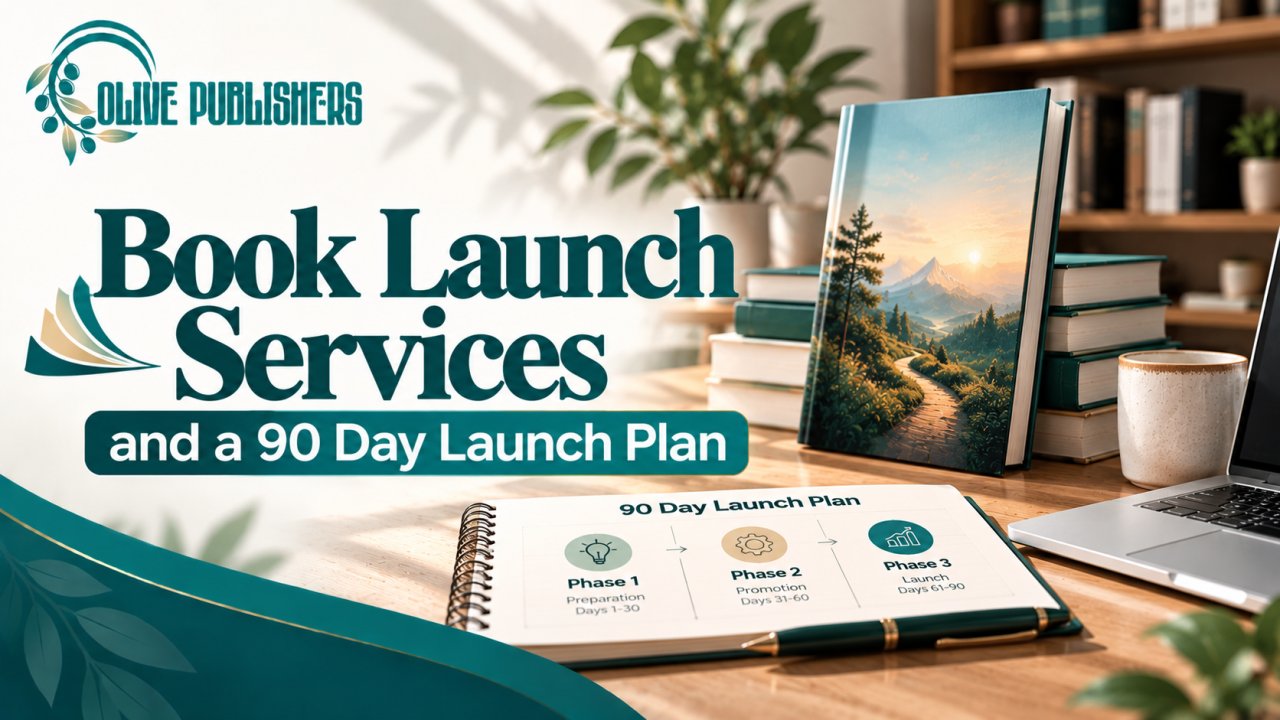
- The 90 day book launch plan at a glance
- Days 90 to 61 establish the foundation
- Set goals you can influence
- Prepare the essentials
- Days 60 to 31 prepare the reader path
- Build an email list with permission
- Line up review copies and outreach
- Days 30 to 15 confirm the details
- Days 14 to 1 build anticipation without overposting
- Launch week coordinate the basics
- Days 1 to 30 after launch learn and adapt
- A sample launch calendar
- Budget, goals, and realistic expectations
- How a launch plan changes by book type
- Product page checklist before release
- How to choose a book launch service
- Comparison table of common launch options
- A practical checklist before you approve
- Common mistakes and how to avoid them
- A realistic example of planning the work
- How Olive Publishers can support your book
- Conclusion
- Frequently Asked Questions
- When should I start planning a book launch?
- What should happen 90 days before publication?
- Do authors need a launch team?
- How much should I spend on a book launch?
- How many reviews should I aim for?
- What should I do on launch day?
- What if my launch gets few sales?
- Should I use paid ads for a launch?
More than 4 million books with ISBNs were published in the United States in 2025, which is 32.5% more than in 2024. Readers have never had more choices, and a book that is simply uploaded and left alone is very easy to miss. This is why book launch services exist. They help authors turn a finished manuscript into a public release that reaches the right readers on purpose instead of by luck.
A launch is not only publication day. It covers preparing the book, building accurate sales pages, reaching likely readers, scheduling promotional content, and learning from the first weeks of response. A 90 day plan gives you a manageable schedule for all of that without promising a guaranteed sales result, because no honest provider can promise one.
Quick answer. A practical 90 day book launch plan starts with preparation and goal setting, moves into audience building and campaign setup, and finishes with release week activity and a 30 day review. The exact schedule depends on your production status, genre, budget, and audience, so adjust it instead of following it blindly.
Why a 90 day book launch plan matters in 2026
Bowker, the agency behind US ISBNs, reported that self-published titles reached roughly 3.5 million in 2025, while traditional publishers released 642,242 titles. Between 2022 and 2025, self-published output grew 43.5% and traditional output grew 10%. In plain terms, authors now compete with millions of new titles every year, and most of them have no launch plan at all.
A 90 day window works well because it matches how readers and platforms behave. Early reviews, email subscribers, and a clean product page need weeks to build. Search and retail algorithms also respond to steady activity more than to a single burst on day one. Starting 90 days out gives you time to fix problems before readers see them.
If you are still deciding how to get your book into the world, read our guide on how to publish your own book in 2026 first, then come back to plan the launch.
What book launch services can cover
Book launch services are a set of tasks, not one fixed product. Depending on the provider and the package, support may include the following.
• Launch schedule and project management with named owners and deadlines
• Metadata work such as categories, keywords, and the book description
• Review of the cover, product page, and author website
• Email list planning and launch email sequences
• Social media content, interview pitches, and media information
• Outreach to reviewers, bloggers, podcasters, and communities that match the book
• Advertising setup and monitoring, including Amazon ads
• Performance reporting and a post-launch review
Before hiring anyone, decide which tasks you will handle and which you will delegate. A launch partner can organize and execute, but it cannot replace your decisions about rights, claims, budget, and the final book. If you want to compare providers, our book marketing services guide explains what typical packages include.
The 90 day book launch plan at a glance
|
Phase |
Timing |
Main goal |
|
Foundation |
Days 90 to 61 |
Lock the manuscript status, goals, audience, budget, and cover direction |
|
Reader path |
Days 60 to 31 |
Build the product page, email list, review copies, and outreach list |
|
Final checks |
Days 30 to 15 |
Verify files, metadata, pricing, links, and scheduled messages |
|
Anticipation |
Days 14 to 1 |
Share useful previews and personal outreach without overposting |
|
Launch week |
Release day and the 6 days after |
Send emails, publish content, and watch for technical errors |
|
Learn and adapt |
Days 1 to 30 after launch |
Review data, fix weak spots, and reuse content |
Days 90 to 61 establish the foundation
The first month is about decisions, not promotion. Confirm the manuscript status, publication date, formats, rights, and who is responsible for each production step. Finish substantive editing before final proofreading and formatting, because changing the text after layout creates avoidable errors.
Set goals you can influence
Sales depend on factors outside your control, so set targets that reflect your own work. Many launch plans use goals such as 300 to 500 email subscribers before release, 20 to 50 advance reader copies sent out, and 25 reviews within the first 90 days. These are starting points. A niche nonfiction book and a romance novel will need different numbers.
Prepare the essentials
• Confirm the cover direction and gather a short, accurate author bio
• Define the audience and the central promise of the book in one sentence
• Get your ISBN sorted. Our guide on how to get an ISBN explains the options for each format
• Create a simple budget with separate lines for production, creative assets, outreach, and paid promotion
• Decide whether you need print, ebook, audiobook, or all three. See how print on demand can reduce upfront printing costs
Cover quality affects every later step, from ads to reviews. If you are still choosing a designer, review the factors in our breakdown of book cover design services cost before you approve a quote.
Days 60 to 31 prepare the reader path
This is the month where you build the path a reader will follow from first hearing about the book to buying it. Review the product description, categories, keywords, author page, and website. Each of these should say the same thing about who the book is for and what it offers.
Build an email list with permission
Email remains the strongest owned channel for authors. Litmus and the DMA report an average return of $36 to $42 for every $1 spent on email marketing in 2026, far above paid search at about $2 per $1. Collect subscribers through permission-based methods such as a sample chapter, a reading guide, or a short newsletter. Never add people who did not ask to hear from you.
Line up review copies and outreach
Recruit 20 to 50 advance readers from your list and give them enough time to read. Never require positive feedback in return for a copy. Identify bloggers, podcasters, and communities whose audiences match your book, and write a short, personal pitch for each. Prepare social posts, a short book summary, and basic media information at the same time.
If the book is in final formatting, use the ebook formatting checklist to catch common file issues before review copies go out.
Days 30 to 15 confirm the details
Now check that everything matches the plan. Cover files, interiors, metadata, pricing, and release settings should all agree with each other. Preview the print and ebook editions on real devices. Test purchase links as soon as the listing is live. Schedule launch messages and confirm who is responsible for each task.
If a production problem appears, protect reader-facing quality over keeping a date at any cost. A delay of one or two weeks is easier to recover from than a book with visible errors. Our article on how long it takes to publish a book helps you judge realistic timelines for each stage.
Days 14 to 1 build anticipation without overposting
Share useful context about the book, such as the problem it explores, a research insight, a character introduction, or the story behind its creation. Each message should be valuable on its own, even to someone who never buys. Send personal outreach to relevant contacts instead of mass messages to people who have not asked to hear from you.
Keep the call to action clear and truthful. One simple request, such as joining the launch email list or saving the release date, works better than five competing requests.
Launch week coordinate the basics
Check that the book page works, the correct edition is visible, and the author website points to the right destination. A launch email sequence of 3 to 5 messages is a common structure, with an announcement on release day, a follow-up with a reader benefit, and a final reminder near the end of the week.
Publish the prepared content and monitor for technical errors. If you are running paid ads, check spending and landing page relevance each day. Avoid making decisions from hourly changes, and look for meaningful patterns across several days instead.
Days 1 to 30 after launch learn and adapt
The first month after release teaches you more than any plan can. Review traffic, clicks, sales, email response, and reader questions. Thank supporters without pressuring anyone to leave a positive review. Reuse your best content in new formats, such as short excerpts, audio clips, or answers to common reader questions.
If the product page has a clear weakness, fix it. If an ad attracts irrelevant clicks, pause or refine it. Once the print and ebook are stable, consider an audiobook to reach readers who prefer listening and to give the book a second round of promotion.
A sample launch calendar
A good schedule names the task, owner, deadline, and status. Keep it short enough to maintain and store it in one shared place if several people are involved.
|
Task |
Owner |
Deadline |
Status |
|
Final proofread complete |
Editor |
Day 75 |
Not started |
|
Cover and interior files approved |
Author and designer |
Day 60 |
Not started |
|
Sample chapter and signup page live |
Author |
Day 55 |
Not started |
|
Review copies sent to 20 to 50 readers |
Author |
Day 40 |
Not started |
|
Metadata and pricing confirmed |
Publisher |
Day 25 |
Not started |
|
Launch emails scheduled |
Marketer |
Day 10 |
Not started |
|
Launch week monitoring |
Whole team |
Release week |
Not started |
|
30 day review meeting |
Author and marketer |
Day 30 after launch |
Not started |
Build in time for file corrections and platform processing. The calendar exists to stop important tasks from being lost, not to force every activity onto one exact date.
Budget, goals, and realistic expectations
There is no universal launch budget. Costs depend on production status, paid advertising, creative assets, events, and outreach. Decide what you can comfortably afford, separate essential production from optional promotion, and avoid debt based on an assumed sales outcome.
Treat the first launch as both a release and a learning cycle. Useful goals include completing the book page, reaching a defined audience, collecting opt-in subscribers, and learning which ad targets are relevant. Compare packages carefully, since a low quote may leave out revisions or reporting. Our overview of self-publishing packages shows what to look for in the scope.
How a launch plan changes by book type
The same 90 day structure works for every genre, but the emphasis shifts. Fiction launches lean on reader communities, review copies, and a strong first chapter sample. Nonfiction launches lean on the author’s expertise, so interviews, guest articles, and speaking opportunities carry more weight. Memoirs depend on a personal story, which makes honest outreach and a clear reason to care especially important.
Children’s books add parents, teachers, and librarians as buyers, so the product page and sample pages must appeal to adults as well as children. Cookbooks, poetry, and coloring books are highly visual, which raises the importance of cover design and interior previews. Whatever the genre, write one sentence that explains who the book is for, and use it everywhere.
Product page checklist before release
Your product page is where interest turns into a purchase, so check it carefully before launch week. Use this short list to review it.
• Title, subtitle, and series details match the cover and interior exactly
• The description opens with the reader’s problem or the story hook, then explains the benefit
• Categories and keywords reflect how real readers search for books like yours
• The author bio is short, accurate, and relevant to the book
• Print, ebook, and audiobook editions are linked together where the platform allows it
• The price is consistent across formats and stores
If you are preparing the ebook yourself, our ebook formatting service page explains how professional conversion avoids layout problems on different reading devices.
How to choose a book launch service
A useful evaluation compares the work delivered with the agreed goal. Ask each provider the same questions so you can compare them fairly.
• What exact deliverables are included, and which are optional?
• Who owns the files, accounts, and email lists created during the project?
• How will progress be reported, and how often?
• How many revision rounds are included?
• Can you show examples of completed work for books similar to yours?
• What do you need from me, and by when?
Be careful with providers who guarantee bestseller status, guarantee a number of sales, or sell reviews. Those promises break platform rules and damage your reputation. For a wider view of the market, see our comparison of self-publishing companies and our guide to choosing the right book publishing agency in New York.
Comparison table of common launch options
|
Option |
Best suited for |
What to confirm |
|
Production preparation |
Books that are not yet finalized |
Owners, dates, and file checks |
|
Audience outreach |
Building awareness before release |
Permission, audience fit, and message |
|
Paid advertising setup |
Books with a finished product page |
Budget, targeting, and tracking method |
|
Post-launch review |
Learning after release |
Metrics, lessons, and next actions |
A practical checklist before you approve
• Confirm the audience and the main purpose of the launch.
• Agree on deliverables, file formats, timeline, revision rounds, and ownership.
• Check platform requirements and current policies instead of relying on old advice.
• Keep approvals and key decisions in writing.
• Review the final work where readers will actually see it, such as the live product page.
• Set realistic expectations and avoid providers who promise guaranteed outcomes.
Common mistakes and how to avoid them
The first common mistake is starting before the manuscript, brief, or rights are ready. The second is assuming a provider’s standard process fits every book. Special formats, tight schedules, sensitive subject matter, and multiple editions need to be discussed early. The third is making late changes without checking what else they affect. Use a change log, approve milestones, and keep final versions so the team can trace decisions.
Authors should also be careful with unsupported claims. Do not promise outcomes the book cannot deliver, use artwork without permission, manipulate reviews, or ignore current platform requirements. Trust is a long-term asset, and accurate descriptions help the right readers choose your book.
A realistic example of planning the work
Imagine an author whose publication date is three months away, but the cover and final edit are unfinished. The launch plan first protects production quality, then schedules metadata, website updates, outreach, and launch content. A short weekly review lets the author see delays early and adjust the campaign instead of rushing an incomplete file live.
How Olive Publishers can support your book
Olive Publishers is a New York based author services company that supports writing, editing, design, publishing, and marketing. The right service depends on your book’s stage and your goals. Before starting, explain what is already complete, what remains, who the target reader is, which formats you plan, and what deadline you have. Ask for a written scope with named deliverables and a realistic schedule.
Authors in New York and across the United States can use that conversation to see which tasks can be handled together and which need separate specialists. If you are based in the city, our Manhattan team page has local details. New authors can also start with our self-publishing guide for new authors.
To discuss your project, contact Olive Publishers with a short description of your book, its current stage, and the support you want.
Conclusion
Book launch services work best when they follow a clear brief, realistic expectations, and close attention to the reader’s experience. Start with your audience and the current stage of the book, confirm the technical and creative requirements, and review the final result before publication. Keep rights and approvals in writing, check current platform guidance, and measure results against the goals you set.
Frequently Asked Questions
When should I start planning a book launch?
Start once the manuscript and publication goals are clear, ideally at least 90 days before release. That gives you time for editing, cover design, formatting, metadata, and outreach. The 90 day plan is a useful framework, not a fixed rule.
What should happen 90 days before publication?
Confirm the manuscript stage, rights, formats, budget, target audience, and responsibilities. Finish editing and begin production planning. Set the release date only after you understand the remaining work and the platform’s processing time.
Do authors need a launch team?
A launch team can share news and give early feedback, but it is optional. Keep participation voluntary, and never ask members to leave positive reviews in exchange for gifts. Give them accurate information and let them decide how to support the book.
How much should I spend on a book launch?
There is no universal number. Costs depend on your resources, production status, advertising, and outreach. Separate essential production from optional promotion, and avoid spending money you cannot afford on an assumed sales outcome.
How many reviews should I aim for?
A common target is 25 reviews within the first 90 days after release. Reach it by sending review copies to 20 to 50 advance readers and asking politely, without pressure or incentives for positive feedback.
What should I do on launch day?
Check the live listing, confirm formats and links, send the planned emails, and publish your prepared content. Respond to reader questions and watch for technical errors. Avoid major budget decisions based on a few hours of data.
What if my launch gets few sales?
Review the book page, audience fit, traffic sources, pricing, and campaign goals before drawing conclusions. A quiet launch does not mean the book is poor. Learn which parts of the plan reached readers and make practical improvements for the next 30 days.
Should I use paid ads for a launch?
Ads can help reach relevant readers, but they need a clear budget and a measurement plan. Make sure the product page is ready, test with a small budget, and track clicks and outcomes instead of spending just to create activity.
Ready to plan your launch? Talk to Olive Publishers about your book and your next steps. You can also explore our book marketing services to see how launch support fits into a full marketing plan.