On this page (35)
- What does perfect bound mean?
- How perfect binding works
- When perfect binding is a good fit
- Perfect binding versus saddle stitching
- Perfect binding versus spiral binding
- Page count and spine width
- Prepare a perfect-bound interior
- Prepare the cover file
- Paper and cover finish
- Durability and opening behavior
- Print on demand or commercial printing
- Proofing checklist
- Mistakes to avoid
- How Olive Publishers can help
- Practical comparison table
- Frequently asked questions
- What should I decide first when planning perfect bound book printing?
- Can a first-time author manage perfect bound book printing without professional help?
- How do I avoid costly mistakes?
- Should I use a free tool or hire a service?
- Does good formatting guarantee book sales?
- What should I ask a publishing service before hiring it?
- How often should I update the book files?
- Preparing Files for Perfect Binding
- Understand the limitations of the spine
- Keep important content away from the gutter
- Decide if the book needs to lie flat
- Review the finished proof from cover to cover
- Final Production Checklist
- Prepare the manuscript for a clean perfect-bound result
- Decide whether perfect binding fits the content
- Check the final product instead of relying only on a preview
- How to prepare for a clean perfect-bound result
- Review the Finished Book Before Approving Production
- Conclusion
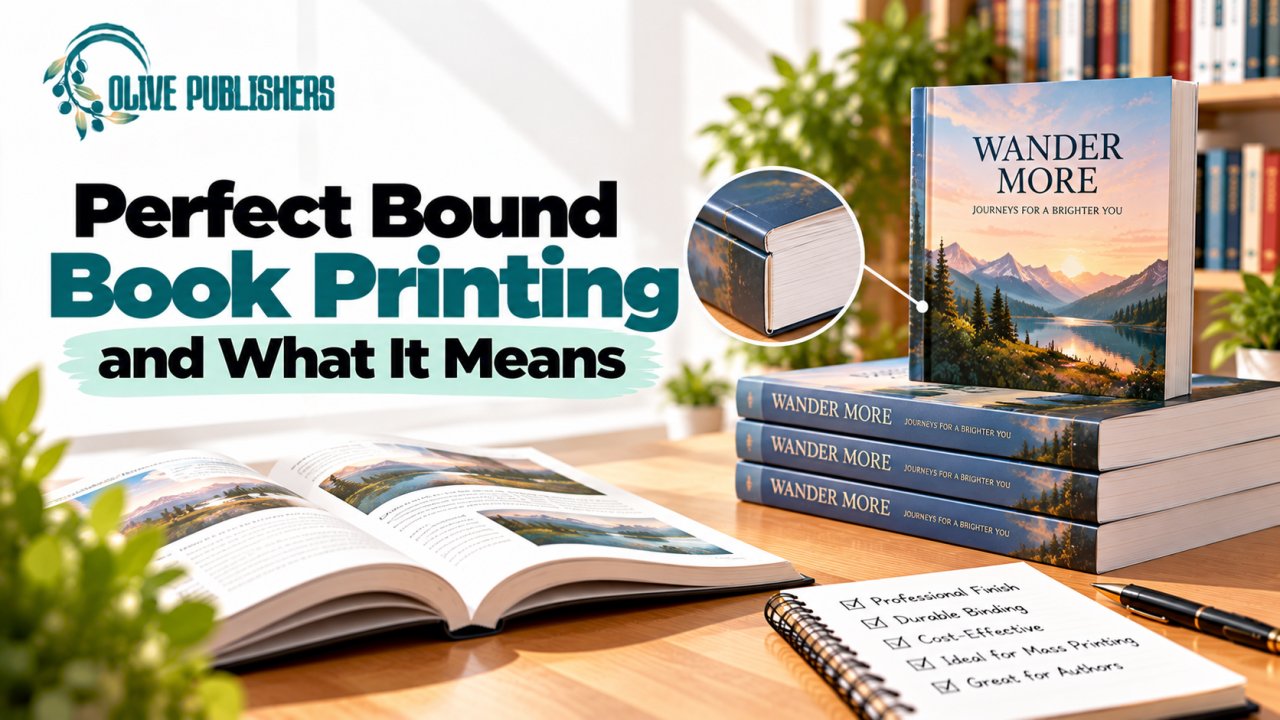
Perfect bound book printing is a common way to produce paperback books with a clean, square spine. The pages are gathered, the binding edge is prepared, and adhesive holds the text block inside a wraparound cover. Understanding the process helps authors plan page layout, cover dimensions, durability, and print-ready files. For authors who want expert help with production, contact olive publishers to discuss the stage of the project and the support needed.
What does perfect bound mean?
Perfect binding is a method in which the pages are secured along one edge with adhesive and attached to a cover. The result is a softcover book with a square spine. It is widely used for paperback books, manuals, catalogs, and other publications with enough pages to form a stable spine.
How perfect binding works
The printer arranges the pages into a text block, prepares the spine edge, applies adhesive, and attaches a cover that wraps around the book. The finished book is trimmed to its final size. Exact production steps vary by printer and adhesive system, so use the provider's specifications for page limits, file setup, and available options.
A training manual may contain diagrams and instructions near the inside edge. With perfect binding, the reader may find those details harder to see if they sit too close to the gutter. A layout review should therefore focus on the inner margin and the way the book opens, not only on whether the PDF passes a technical check.
When perfect binding is a good fit
Perfect binding suits novels, memoirs, business books, guides, and many other books that need a conventional retail appearance. It gives the cover a printable spine, which can help a book look organized on a shelf. It is less suitable when the book must lie fully flat, such as some cookbooks, workbooks, or technical manuals.
Perfect binding versus saddle stitching
Saddle-stitched booklets are folded and stapled at the center. They are generally used for shorter publications. Perfect binding creates a square spine and can accommodate thicker page blocks, subject to the printer's limits. Compare the page count, durability, cost, and intended use before deciding.
Perfect binding versus spiral binding
Spiral binding lets pages rotate around a coil and can make a book lie flat. Perfect binding looks more like a conventional paperback and is often better suited to retail book distribution. The best choice depends on whether appearance, writing space, ease of reference, or the ability to open flat matters most.
For a novel, perfect binding may offer the conventional paperback look the audience expects. The author still needs to review spine alignment, title placement, and cover contrast. The spine is narrow on short books, so text should only be added if the final dimensions allow it.
Page count and spine width
Spine width depends on the number of pages and the selected paper stock. Do not calculate it from page count alone unless the printer provides the correct formula for that stock. A cover made with the wrong spine width may have text shifted off-center or panels that do not align. Generate the cover using the printer's current template.
Prepare a perfect-bound interior
Use the correct trim size, margins, gutter, page numbering, chapter styling, and bleed for full-page images. Keep essential text away from the binding edge because the book may not open completely flat. Review the first and last pages, blank pages, and any content that crosses a spread.
Prepare the cover file
A perfect-bound cover normally includes the back cover, spine, and front cover in one wraparound design. The file may also need bleed and a safe area around text. Add spine text only if the printer's minimum page count or spine-width rules allow it. Use the supplied template instead of copying dimensions from another book.
A training manual may contain diagrams and instructions near the inside edge. With perfect binding, the reader may find those details harder to see if they sit too close to the gutter. A layout review should therefore focus on the inner margin and the way the book opens, not only on whether the PDF passes a technical check.
Paper and cover finish
Interior paper affects weight, opacity, and the overall thickness of the book. Cover stock and finish affect how the book looks and feels. Gloss may enhance bright artwork, while matte can create a softer look and reduce reflections. Confirm which finishes are offered for the selected binding and distribution service.
Durability and opening behavior
Perfect-bound books do not usually open as flat as spiral-bound books. Readers may need to hold the pages open, and content too close to the gutter can become difficult to read. Binding strength depends on construction, paper, adhesive, and use. For a book expected to be handled frequently, ask the printer about the available binding options.
Print on demand or commercial printing
Print-on-demand platforms can make a perfect-bound paperback available without a large upfront inventory. Commercial printers may offer different paper choices and per-copy economics at higher quantities. Compare total costs, shipping, turnaround, quality control, and how copies reach readers. The lowest quote may not include every service you need.
For a novel, perfect binding may offer the conventional paperback look the audience expects. The author still needs to review spine alignment, title placement, and cover contrast. The spine is narrow on short books, so text should only be added if the final dimensions allow it.
Proofing checklist
Before approval, inspect the spine, front and back cover alignment, text near the gutter, page sequence, image sharpness, trim, paper shade, and cover finish. Open the physical proof as a reader would. Check the barcode area if required and ensure all title, author, and publisher details are correct.
Mistakes to avoid
Do not create a cover before the final page count is locked. Do not use spreads when the printer asks for single pages. Avoid putting key text near the binding edge, and never assume a PDF preview confirms physical quality. Correct source files and upload a clean revision when changes are needed.
How Olive Publishers can help
Olive Publishers offers book formatting, cover design, editing, publishing, and marketing support. Authors preparing a perfect-bound paperback can discuss the trim size, page count, printer requirements, and current state of their files with the team. Clear specifications help ensure the interior and cover are prepared for the same production setup.
Practical comparison table
|
Decision area |
Option A |
Option B |
|
Perfect bound |
Square spine, paperback appearance |
Does not usually lie fully flat |
|
Saddle stitched |
Useful for short booklets |
Limited by page count and format |
|
Spiral |
Can lie flat |
Different retail appearance |
Frequently asked questions
What should I decide first when planning perfect bound book printing?
Start with the book's audience, purpose, format, and intended sales channels. Those choices affect layout, cover design, production options, and budget. Confirm the chosen platform's current requirements before finalizing files, and keep a written checklist so design and production decisions stay consistent.
Can a first-time author manage perfect bound book printing without professional help?
Yes, many authors handle some stages themselves, especially when the book has a simple text layout. The trade-off is time spent learning tools and checking technical details. Professional help may be useful for complex layouts, illustrations, multiple editions, or when errors would be costly to correct after release.
How do I avoid costly mistakes?
Use current instructions from the selected printer or retailer, keep the source files editable, and review a representative sample before formatting or producing the entire book. Check dimensions, page order, images, links, metadata, and cover details. A final proof review is safer than relying only on an on-screen preview.
Should I use a free tool or hire a service?
Choose based on the complexity of the project and your confidence with the work. Free tools can be enough for straightforward projects, while a specialist can help with design, editing, or technical setup. Compare the exact deliverables and support offered instead of assuming a free or paid option is always better.
Does good formatting guarantee book sales?
No. Formatting helps readers use the book and signals care, but sales also depend on content, audience fit, pricing, distribution, discoverability, reviews, and marketing. Treat production quality as one part of a wider publishing plan rather than a promise of commercial success.
What should I ask a publishing service before hiring it?
Ask for a written scope, timeline, deliverables, revision policy, file formats, payment schedule, ownership terms, and a list of exclusions. Confirm who controls publishing accounts and whether you receive editable source files. A reliable discussion should clarify what the service can do without promising a sales outcome.
How often should I update the book files?
Update files when you correct meaningful errors, change the content, or need to meet a platform's revised technical requirements. Keep versioned copies and note what changed. Before uploading an update, review the exported files again because a small source edit can affect page breaks, links, images, or the cover dimensions.
Preparing Files for Perfect Binding
Understand the limitations of the spine
A perfect-bound spine has limited space, especially on a short book. Spine text may be omitted when it cannot fit clearly or when the printer has a minimum thickness rule. Never stretch or squeeze the cover design just to force a title onto the spine. The title should remain readable and centered after trimming and binding. Use the exact cover template generated for the selected page count and paper stock.
Keep important content away from the gutter
The inner margin is easy to overlook because a PDF preview shows pages flat and fully visible. In a physical book, the reader's view can be affected by the binding. Avoid placing key words, page numbers, diagram labels, or important image details close to the spine. If content must span a spread, check whether the binding style is suitable and whether the printer can maintain alignment.
Decide if the book needs to lie flat
A recipe book, training workbook, or technical manual may be used with both hands busy. Perfect binding can be a poor fit if readers need the pages to remain open on a desk. Spiral or wire-o binding may work better for such use, though it changes the appearance and retail options. Test the book's real use case before selecting a binding method based only on shelf appeal.
Review the finished proof from cover to cover
Check the cover wrap, spine, page order, margins, text size, images, and paper. Open the proof naturally instead of forcing it flat. Look for pages that are difficult to read near the binding and verify that the cover does not shift around the text block. If a correction changes the page count, regenerate the cover rather than assuming the existing spine still fits.
Final Production Checklist
Confirm trim size, paper, binding, page count, margins, bleed, cover template, file type, proofing process, quantity, shipping, and delivery date. Use the selected printer's current instructions. Inspect the final proof carefully and save the approved files with clear version names.
Prepare the manuscript for a clean perfect-bound result
Use a consistent trim size and set margins with the binding edge in mind. Apply heading and paragraph styles instead of spacing text with repeated returns. Check chapter openings, page numbers, running heads, and blank pages. If an image reaches the edge of the page, follow the printer's bleed instructions. Make sure all important captions and diagram labels stay away from the gutter.
A square spine depends on the final text block, so do not finish the cover while the interior is still changing. If edits add or remove pages, the spine width may change. Use the cover template generated for the final page count and paper choice, then inspect the spine alignment in the proof.
Decide whether perfect binding fits the content
Perfect binding is a familiar choice for many paperbacks, but the right binding depends on the way readers use the book. A novel or memoir usually does not need to lie flat. A workbook that readers fill in while working may be easier to use with a spiral or wire-o binding. A short booklet may work well with saddle stitching. Compare practical use, appearance, page count, and availability before selecting.
If a conventional retail look matters, perfect binding may be suitable. If hands-free page access matters more, another method may be worth considering. Test a sample when the book's use case makes opening behavior important.
Check the final product instead of relying only on a preview
A PDF preview can show page order and many layout problems, but it cannot fully show how the physical book opens, feels, or aligns after trimming. Review a printed proof if possible. Check the cover wrap, spine position, paper, page sequence, margins, image detail, and text near the binding. Turn pages at a normal pace and notice whether any content becomes hard to see.
Write down every correction and check the revised proof against the list. Keep the approved files and note the version that was sent to the printer. This creates a reliable reference if a later reprint is needed.
How to prepare for a clean perfect-bound result
Review the inside edge of every page before exporting the final file. Perfect-bound books do not open as flat as some other binding styles, so text, page numbers, and important details should not sit too close to the spine. The exact safe area depends on the printer's requirements and the book's thickness; use the current template rather than applying a universal measurement.
Check that the page count meets the selected printer's minimum and maximum requirements and that the interior PDF has the correct page size. The cover file is a separate production layout and normally includes the back cover, spine, and front cover in one spread. Spine width should be calculated using the printer's specifications after the interior and paper choice are final.
Order and inspect a proof before approving a larger quantity. Look for a crooked cover, uneven trimming, adhesive issues, missing pages, and content that becomes difficult to read near the spine. A proof also helps you judge whether the book feels right in the hand and whether the cover finish suits the purpose of the title.
Review the Finished Book Before Approving Production
When the proof arrives, check more than the cover design. Confirm that the pages are in the right order, the text is readable near the spine, the trim is even, and the cover is aligned with the interior. If the book includes images, inspect their placement and resolution at print size. Record any corrections clearly and review the revised proof before authorizing the final run.
Conclusion
Perfect bound book printing creates the familiar square-spined paperback used for many books and manuals. It works best when the page count, paper, cover template, margins, and intended reader experience are planned together. Follow the printer's current instructions and approve a physical proof before releasing the book.
Need help coordinating your next publishing step? Contact Olive Publishers to discuss your book's production needs.