On this page (25)
- Introduction
- Ghostwriting an Autobiography
- How Autobiography Ghostwriting Works
- What Makes Autobiography Ghostwriting Different
- Ghostwriting a Novel
- How Novel Ghostwriting Works
- Fiction vs. Non Fiction Novel Ghostwriting
- Ghostwriting a Children’s Book
- How Children’s Book Ghostwriting Works
- What Makes Children’s Book Ghostwriting Different
- How Much Do These Types of Ghostwriting Cost?
- How Long Does Each Type Take?
- What Should You Look for in Each Type of Ghostwriter?
- Common Mistakes to Avoid Across All Three
- Memoir vs. Autobiography: Is There a Difference for Ghostwriting Purposes?
- How Sensitive Material Gets Handled in Autobiography Ghostwriting
- Series Planning for Novel Ghostwriting
- What Illustrators Look for From a Children’s Book Manuscript
- How to Choose Between These Three Formats If You’re Unsure
- What an Interview Session Actually Looks Like for an Autobiography
- Handling Multiple Points of View in a Novel
- Why Read-Aloud Testing Matters for Children’s Books
- Autobiography, Novel, and Children’s Book Industry Snapshot
- Conclusion
- FAQs
Introduction
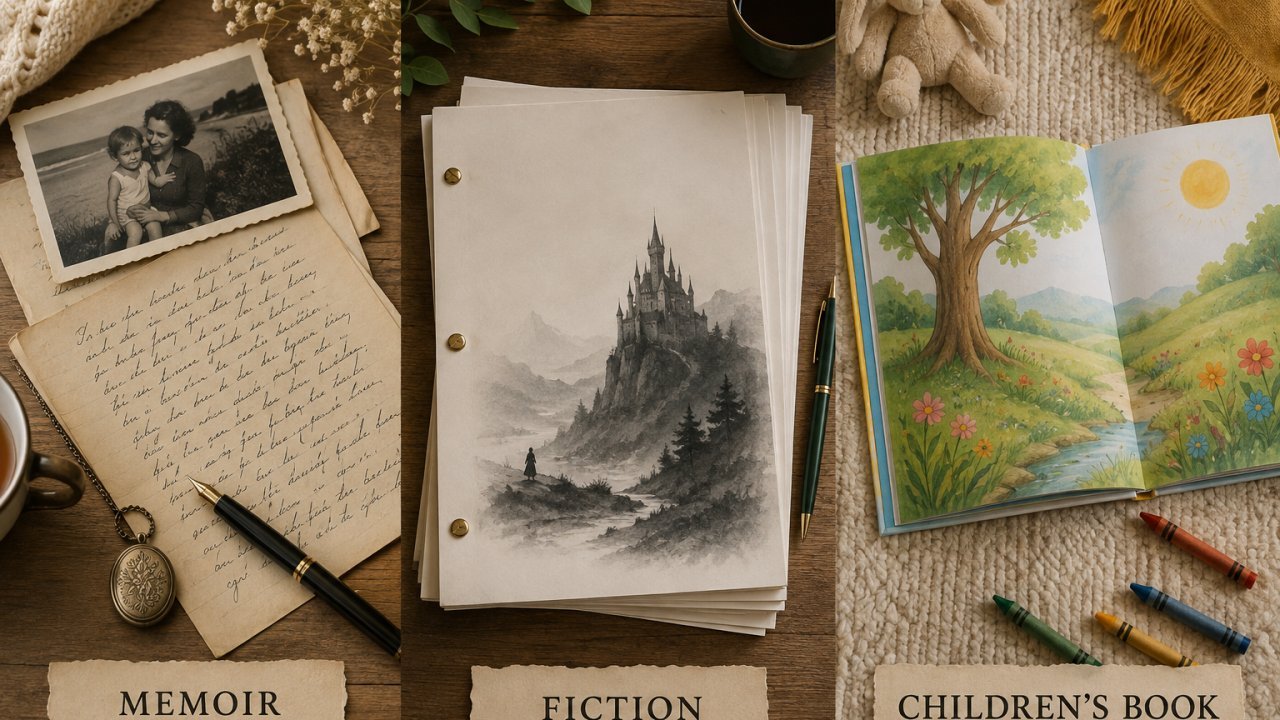
Yes. Ghostwriters regularly work on autobiographies, novels, and children’s books, though each type requires a different process. Autobiographies rely heavily on interviews and personal storytelling, novels require plotting and fiction craft (whether fiction or non fiction in style), and children’s books demand a completely different writing approach built around simplicity, rhythm, and age-appropriate language.
If you’ve got a life story worth telling, a novel idea you can’t seem to finish, or a children’s book concept sitting in a notebook somewhere, a ghostwriter can take that idea and turn it into a finished manuscript. But these three categories work pretty differently from each other. Here’s what to expect from each one.
Ghostwriting an Autobiography
An autobiography is your life story, told from your perspective, even though someone else is doing the writing. This is one of the most personal forms of ghostwriting since the entire book is built from your memories, experiences, and voice.
How Autobiography Ghostwriting Works
Extensive interviews: This is the core of the process. Autobiography ghostwriters typically conduct many hours of interviews, sometimes 15–30 sessions, to gather stories, timelines, and personal details.
Research and fact-checking: For events, dates, and named people, the ghostwriter cross-checks details against your memory to keep the narrative accurate.
Narrative structuring: Life doesn’t happen in a neat, readable order. Part of the ghostwriter’s job is organizing your story into a structure that keeps readers engaged, whether that’s chronological or theme-based.
Voice matching: Since this is your personal story, the writing needs to sound like you specifically, not a generic narrator. This takes longer to nail down than in other types of ghostwriting.
What Makes Autobiography Ghostwriting Different
Unlike a business book or novel, autobiography ghostwriting deals with emotionally sensitive material. Good autobiography ghostwriters are skilled at asking the right questions to draw out meaningful stories, including ones you might not think to mention on your own.
Ghostwriting a Novel
Novel ghostwriting, whether fiction or non fiction in structure, follows a more traditional fiction-writing process, focused on plot, character, and pacing rather than personal interviews.
How Novel Ghostwriting Works
Concept development: You bring the idea, whether that’s a fully outlined plot or just a character and a premise.
Outlining: The ghostwriter builds a chapter-by-chapter outline covering major plot points, character arcs, and pacing.
Drafting: Chapters get written in batches, giving you the chance to review and adjust direction before the whole manuscript is finished.
Revisions: You give feedback on plot, character voice, and pacing, and the ghostwriter revises accordingly.
Fiction vs. Non Fiction Novel Ghostwriting
Fiction novel ghostwriting focuses on invented characters, plot, and world details. Non fiction “novel-style” writing, sometimes used for narrative nonfiction or fictionalized true stories, blends factual accuracy with storytelling techniques like scene-setting and dialogue. If your project blends real events with a novelistic style, make sure your ghostwriter has experience in narrative nonfiction specifically, not just straight fiction.
Ghostwriting a Children’s Book
Children’s book ghostwriting is its own specialty and doesn’t overlap much with adult fiction or nonfiction writing.
How Children’s Book Ghostwriting Works
Age-range targeting: The ghostwriter needs to know the target age group (picture book, early reader, middle grade) since vocabulary, sentence length, and themes shift a lot across these categories.
Concept and story development: Many children’s books are built around a simple, clear lesson or theme. The ghostwriter helps shape your idea into a story arc that fits a short page count.
Rhythm and read-aloud quality: Picture books especially are read aloud, so word choice and sentence rhythm matter more here than in most other writing types.
Illustration notes: Since children’s books are highly visual, ghostwriters often include illustration notes or page-break suggestions, even if they’re not doing the artwork themselves.
What Makes Children’s Book Ghostwriting Different
Word count is dramatically shorter, often under 1,000 words for picture books, but the writing process isn’t necessarily faster. Every word has to earn its place, and getting the tone right for a specific age group takes real skill.
How Much Do These Types of Ghostwriting Cost?
Autobiography: $15,000–$60,000, depending on length, number of interviews, and complexity of the life story.
Novel: $10,000–$50,000, depending on word count, genre, and whether it’s a single book or part of a series.
Children’s book: $500–$5,000, depending on length, age range, and whether illustration coordination is included.
How Long Does Each Type Take?
Autobiography: Typically six months to a year, given the volume of interviews and fact-checking involved.
Novel: Usually four to nine months, depending on length and how many revision rounds are needed.
Children’s book: Often just four to eight weeks, since the word count is so much shorter.
What Should You Look for in Each Type of Ghostwriter?
For an autobiography ghostwriter, look for strong interviewing skills and experience handling personal, sometimes sensitive, material with care.
For a novel ghostwriter, ask for writing samples in your specific genre and check how they handle plot structure and character development.
For a children’s book ghostwriter, review past work for read-aloud quality and ask how they approach age-appropriate language.
Common Mistakes to Avoid Across All Three
• Not clarifying the target audience or age range before starting a children’s book
• Skipping interview prep for an autobiography, which leads to shallow, generic stories
• Choosing a novel ghostwriter without genre-specific samples
• Assuming illustration is automatically included with children’s book ghostwriting
• Not setting a clear structure or outline before drafting begins on any of these three formats
Memoir vs. Autobiography: Is There a Difference for Ghostwriting Purposes?
These terms get used interchangeably, but there’s a real distinction that affects how a ghostwriter approaches the project.
Autobiography typically covers your entire life story, told chronologically from birth (or early life) to the present.
Memoir focuses on a specific theme, period, or experience in your life, like overcoming an illness, building a business, or navigating a major life transition, rather than covering everything.
If you’re not sure which one fits your project, a good ghostwriter will help you figure that out during the discovery call based on what story you actually want to tell and who you’re telling it for.
How Sensitive Material Gets Handled in Autobiography Ghostwriting
Life stories often include difficult chapters, like loss, trauma, or conflict with other people. Experienced autobiography ghostwriters handle this by:
• Letting you control how much detail goes into sensitive sections
• Checking in regularly about tone and comfort level as the material develops
• Being mindful of how other real people are portrayed, especially where legal exposure could be a concern
• Offering to pause or revisit especially difficult topics rather than pushing through in one sitting
If your story involves other identifiable people, it’s worth discussing with a lawyer whether any sections need review before publication, separate from the ghostwriter’s work.
Series Planning for Novel Ghostwriting
If your novel is meant to be part of a series, it’s worth raising that during the very first conversation. Planning a series in advance affects:
• How much world and character depth gets built into book one
• Whether certain plot threads get left open intentionally
• Pricing, since many ghostwriters offer a discount for committing to multiple books upfront
• Consistency, since working with the same ghostwriter across a series keeps voice and world details aligned
Trying to retrofit a sequel onto a book that wasn’t planned with a series in mind is possible, but it’s usually more work than planning ahead.
What Illustrators Look for From a Children’s Book Manuscript
Even though ghostwriters typically don’t illustrate, a well-written children’s book manuscript makes the illustrator’s job much easier. Good manuscripts include:
• Clear page-break suggestions showing where one spread ends and the next begins
• Enough visual detail in the text to guide illustration choices, without over-describing every detail
• Consistent pacing so illustrations can build tension or humor alongside the words
• Room left for visual storytelling, since children’s books rely on pictures to carry part of the narrative, not just the text
A ghostwriter experienced in children’s books will naturally write with these illustration handoffs in mind, even without doing the artwork themselves.
How to Choose Between These Three Formats If You’re Unsure
If you’re not sure whether your project is better suited as an autobiography, a novel, or something else entirely, ask yourself:
• Is this a true story about my own life? That points toward autobiography or memoir.
• Is this an invented story, even if inspired by real events? That points toward a novel.
• Is the intended reader a child, and is the story built around a simple lesson or theme? That points toward a children’s book.
A good ghostwriter can also help you figure this out during an initial conversation if you’re still deciding between formats.
What an Interview Session Actually Looks Like for an Autobiography
Clients are often unsure what to expect walking into their first interview session. Typically, sessions run 60 to 90 minutes and are recorded (with your permission) for accuracy. The ghostwriter usually comes with a loose set of questions organized around a specific life period or theme, but the conversation stays flexible so unexpected stories can surface naturally. After each session, the ghostwriter reviews the recording, pulls out usable material, and often follows up with clarifying questions before the next call. Over many sessions, this builds a large pool of raw material that eventually gets shaped into chapters.
Handling Multiple Points of View in a Novel
If your novel involves multiple POV characters, this adds complexity that’s worth discussing with your ghostwriter early on. Things to plan for include:
• How many POV characters the story actually needs, since too many can dilute reader connection
• Whether POV switches happen by chapter, by scene, or some other structure
• Keeping each character’s voice distinct enough that readers can tell whose perspective they’re in
• Balancing how much page time each POV character gets across the full manuscript
A ghostwriter experienced in multi-POV fiction will map this out during the outlining stage rather than figuring it out chapter by chapter, which helps avoid pacing problems later in the draft.
Why Read-Aloud Testing Matters for Children’s Books
Because picture books are read aloud far more often than read silently, testing the manuscript out loud during the writing process catches problems that are easy to miss on the page. Ghostwriters experienced in children’s books often:
• Read drafts aloud themselves to check rhythm and flow
• Watch for tongue-twisters or awkward phrasing that trips up a reader mid-sentence
• Time how long a full read-aloud takes, since attention spans for the target age group are limited
• Test whether the story’s key moment or punchline lands clearly when spoken, not just when read
If you’re reviewing a children’s book draft yourself, reading it out loud to a child in the target age range is one of the best ways to spot what’s working and what isn’t before finalizing the manuscript.
Autobiography, Novel, and Children’s Book Industry Snapshot
A few data points worth knowing about these three categories specifically:
• Memoir and autobiography ghostwriting consistently rank as one of the most requested ghostwriting services, with some industry reports placing memoir work as the single largest category of ghostwritten projects
• Business and self-help nonfiction narrowly trails memoir in project volume, showing how much overlap exists between personal storytelling and professional branding goals
• Fiction ghostwriting, including novels, represents a smaller but steadily growing share of the market as self-publishing has made it easier for first-time novelists to release a finished book without a traditional publishing deal
• Children’s picture books remain a distinct, high-demand niche within publishing generally, driven partly by parents and grandparents wanting to create personalized or family-specific stories, in addition to authors targeting the broader children’s market
Conclusion
Autobiographies, novels, and children’s books each demand a different ghostwriting approach, but all three are common, well-established services. Autobiographies rely on deep interviews and careful narrative structuring. Novels need strong plotting and genre-specific craft. Children’s books require simplicity, rhythm, and a sharp sense of what lands with young readers. Picking a ghostwriter with direct experience in your specific format makes the biggest difference in how the finished book turns out.
FAQs
How many interviews does an autobiography usually require? Most autobiography projects involve 15 to 30 interview sessions, depending on the depth and length of the life story being told.
Can a ghostwriter write a novel from just an idea, without a full outline? Yes, many ghostwriters help build the outline as part of the process, so you don’t need a complete plot mapped out before reaching out.
What age ranges do children’s book ghostwriters typically cover? Common categories include board books (ages 0–3), picture books (ages 3–8), and early readers (ages 6–9), each with different word count and vocabulary needs.
Do children’s book ghostwriters also illustrate the book? Usually not. Most focus purely on the text and either recommend an illustrator or leave that step to the client.
Is it harder to ghostwrite an autobiography than a novel? They require different skills rather than one being harder. Autobiographies demand strong interviewing and organizational skills, while novels demand strong plotting and fiction craft.
Can a novel ghostwriter work in a genre they haven’t written before? It’s possible, but it’s better to choose someone with direct experience in your genre, since genre conventions around pacing and tone vary a lot.