On this page (13)
- Table of Contents
- What Does It Mean to Make a Book
- Who This Guide Is Best For
- How to Make a Book Step by Step
- What Do You Need to Make a Book
- Self Publishing vs Traditional Publishing vs Hybrid Publishing
- How to Make a Book for First Time Authors
- How to Market a Book After It Is Made
- Which Metrics Actually Prove Your Book Is Working
- Common Mistakes That Slow Authors Down When Making a Book
- Why Authors Work With Olive Publishers
- Start Making Your Book Today
- Frequently Asked Questions About How to Create a Book
Learning how to make a book feels like a mountain of decisions when you're staring at a blank page or a finished manuscript with no idea what comes next. The good news is that book creation breaks down into a clear sequence of stages that any author can follow, whether you're writing your first novel or turning years of expertise into a business book.
Making a book involves five core phases. You write and edit the manuscript, design the interior and cover, format it for print or digital, register it with an ISBN and metadata, then publish and market it through the right channels. Most first time authors complete the full process in three to nine months, depending on the length and complexity of the project.
- Write, edit and finalize your manuscript before touching design or formatting
- Choose your publishing path early (self publishing, traditional or hybrid)
- Invest in professional editing plus cover and interior design
- Secure an ISBN, write strong metadata and pick your distribution channels
- Build a marketing plan before launch day, not after
Table of Contents
- What Does It Mean to Make a Book
- Who This Guide Is Best For
- How to Make a Book Step by Step
- What Do You Need to Make a Book
- Self Publishing vs Traditional Publishing vs Hybrid Publishing
- How to Make a Book for First Time Authors
- How to Market a Book After It Is Made
- Which Metrics Actually Prove Your Book Is Working
- Common Mistakes That Slow Authors Down
- Why Authors Work With Olive Publishers
- Frequently Asked Questions
- Start Making Your Book Today
What Does It Mean to Make a Book
Making a book means taking a written manuscript through editing, design, formatting and production until it becomes a finished product a reader can buy in print, as an ebook or as an audiobook. The word "book" covers several different end products, so the process changes slightly depending on which one you're building.
A print book requires a laid out interior file, a cover with front and back panels plus a spine, and a print ready PDF sent to a printer or a print on demand platform. An ebook needs a reflowable or fixed layout file such as EPUB or MOBI that works across devices like Kindle, Apple Books and Kobo. An audiobook needs a narrated audio file, usually produced after the print or ebook edition is locked.
2025 was the biggest year in US publishing history by volume. Bowker data shows more than 4.1 million new titles were issued ISBNs in the US in 2025, a 32.5% jump over 2024, driven almost entirely by self published titles which grew 38.7% year over year to surpass 3.5 million. Self published books now outnumber traditionally published titles by more than 5 to 1. That surge means competition for reader attention is fierce, which is exactly why the quality of how you make your book (not just whether you finish it) matters more in 2026 than it did a decade ago.
Who This Guide Is Best For
This guide is built for authors who already have a manuscript in progress or finished, along with authors who are still outlining their first book but want to understand the full path from draft to published product. It's also useful for business owners, coaches and consultants who want a book as a credibility tool rather than a primary income source.
This guide (and working with a publishing service like Olive Publishers) is less useful for you if you're only looking for a free hobbyist tool to format a single short document with no plans to distribute it publicly, or if you already have an in house design and editorial team through a traditional publishing contract. Traditional deal authors follow a different process managed largely by their publisher.
How to Make a Book Step by Step
How to make a book step by step comes down to ten stages that carry a manuscript from idea to published product. Skipping stages is the single biggest reason self published books look unfinished. Here is the full process of making a book in the order that professional publishers actually follow it.
Step 1. Decide What You're Writing and Outline It
Before you write a single chapter, define the book's purpose, audience and format. Fiction authors typically build a plot outline or a loose "beat sheet," while nonfiction authors build a chapter by chapter table of contents that doubles as a working outline. This single step prevents the most common cause of unfinished manuscripts, which is losing direction halfway through the first draft.
Step 2. Write the First Draft
With an outline in hand, write consistently rather than perfectly. Most working authors aim for a fixed word count target, somewhere between 300 and 1,500 words a day, and treat the first draft as raw material rather than a finished product. A typical novel runs 70,000 to 100,000 words, while a nonfiction business book often lands between 30,000 and 50,000 words.
Step 3. Edit and Revise the Manuscript
Editing happens in layers. Developmental editing looks at structure, pacing and argument strength. Line editing tightens sentence level clarity and voice. Copy editing catches grammar, consistency and factual errors. Proofreading is the final pass before the file goes to design. Skipping any of these layers is one of the fastest ways to lose reader trust once the book is live, since even a strong story or argument gets undermined by sloppy execution.
Step 4. Design the Cover and Interior
A reader forms a purchase opinion about your book cover within seconds, so this step deserves real design investment rather than a template thrown together in an afternoon. Interior design covers font choice, margins, chapter openers, page numbers and front matter such as the title page and copyright page. Genre fiction, children's books, cookbooks and business nonfiction each have their own visual conventions that signal professionalism to readers browsing a retail page.
Step 5. Format for Print and Digital
Formatting turns your designed file into the exact technical specs each platform requires. Print files need bleed, trim size and a print ready PDF matched to your binding type. Ebook files need reflowable EPUB formatting so text resizes correctly across devices. Getting formatting wrong is one of the most common reasons a manuscript gets rejected or flagged during upload to Amazon KDP, IngramSpark or a print on demand service.
Step 6. Secure an ISBN and Write Your Metadata
An ISBN is the unique identifier that lets retailers, libraries and distributors track your specific edition. You need a separate ISBN for each format (paperback, hardcover, ebook), since they're treated as distinct products. Metadata is the descriptive information wrapped around that ISBN, including your title, subtitle, author name, book description, keywords and category selections. Strong metadata is effectively free discoverability, since it's what search engines and retailer algorithms use to match your book to a searching reader.
Step 7. Choose Your Publishing Path
At this point you decide between self publishing, traditional publishing or a hybrid model. This decision affects your timeline, your control over the final product and how you'll earn royalties. We cover the full comparison below.
Step 8. Publish and Distribute
Publishing means uploading your final files to your chosen platforms (Amazon KDP, IngramSpark, Apple Books, Barnes & Noble Press and others) and setting your pricing, territories and royalty options. Wide distribution across multiple retailers gives you more shelf space, while an Amazon exclusive approach through KDP Select unlocks Kindle Unlimited reads in exchange for exclusivity.
Step 9. Market and Launch the Book
A book without a marketing plan behind it rarely finds readers on its own, no matter how well written it is. We go deep on this stage in the marketing section below, since it's the stage most first time authors underestimate.
Step 10. Track Performance and Keep Selling
Publishing day is the beginning of a book's commercial life, not the end of it. Backlist marketing, meaning ongoing promotion of books published months or years earlier, is often where self published authors build sustainable income, since a strong backlist compounds every new title's launch.
What Do You Need to Make a Book
What do you need to make a book depends on the format, but every author needs the same five core inputs regardless of genre. You need a finished, edited manuscript, a professional cover design, an interior layout formatted for your chosen format, an ISBN with complete metadata and a plan for distribution plus marketing.
Beyond those five essentials, most authors also need writing or formatting software (Word, Google Docs, Scrivener or Vellum), a style guide such as Chicago Manual of Style for nonfiction, beta readers or an editor for feedback and a modest production budget. A professionally produced book, covering editing, cover design, formatting and a launch push, commonly runs anywhere from a few hundred dollars for a bare bones DIY approach to several thousand dollars for a fully managed service. Free tools exist for every step, but the tradeoff is almost always time and finished quality.
Self Publishing vs Traditional Publishing vs Hybrid Publishing
Choosing a publishing path shapes everything from your timeline to how much of the sale price you keep. Here's how the three main routes compare.
| Factor | Self Publishing | Traditional Publishing | Hybrid Publishing |
|---|---|---|---|
| Time to publish | Weeks to a few months | 12 to 24 months or longer | A few months |
| Creative control | Full control | Limited, publisher decides cover, title and edits | High, author retains most decisions |
| Royalties | 35% to 70% depending on platform | Typically 10% to 15% of net | Often 50% or higher |
| Upfront cost | Author pays for editing, design, formatting | Author usually pays nothing upfront | Author pays a package fee |
| Rights ownership | Author keeps all rights | Publisher holds rights | Varies by contract, often author retained |
| Best for | Authors who want speed and control | Authors seeking an advance and wide bookstore placement | Authors who want professional support without giving up rights |
None of these three paths is objectively "better." A first time memoirist who wants full creative control and a fast timeline usually leans self published or hybrid, while a debut novelist chasing a six figure advance and national bookstore placement pursues the traditional route through literary agents.
How to Make a Book for First Time Authors
Making a book for the first time is genuinely different from doing it as a repeat author, mostly because first time authors don't yet know which decisions matter and which ones don't. If this is your first project and you find yourself thinking "I want to make a book but I have no idea where to start," these adjustments will save you real time and money.
Start smaller than you think you need to. A shorter, tightly edited 150 page book beats a bloated 400 page manuscript every time, especially for nonfiction. Get outside feedback early, ideally from beta readers or a developmental editor, rather than waiting until the manuscript feels "done" in your own head. Budget for professional editing and cover design before you budget for advertising, since a beautifully marketed but poorly edited book generates negative reviews faster than an unmarketed one. Finally, resist the urge to skip metadata and categorization. New authors often treat this step as an afterthought, when it's actually one of the highest leverage, lowest cost parts of the entire process.
How to Market a Book After It Is Made
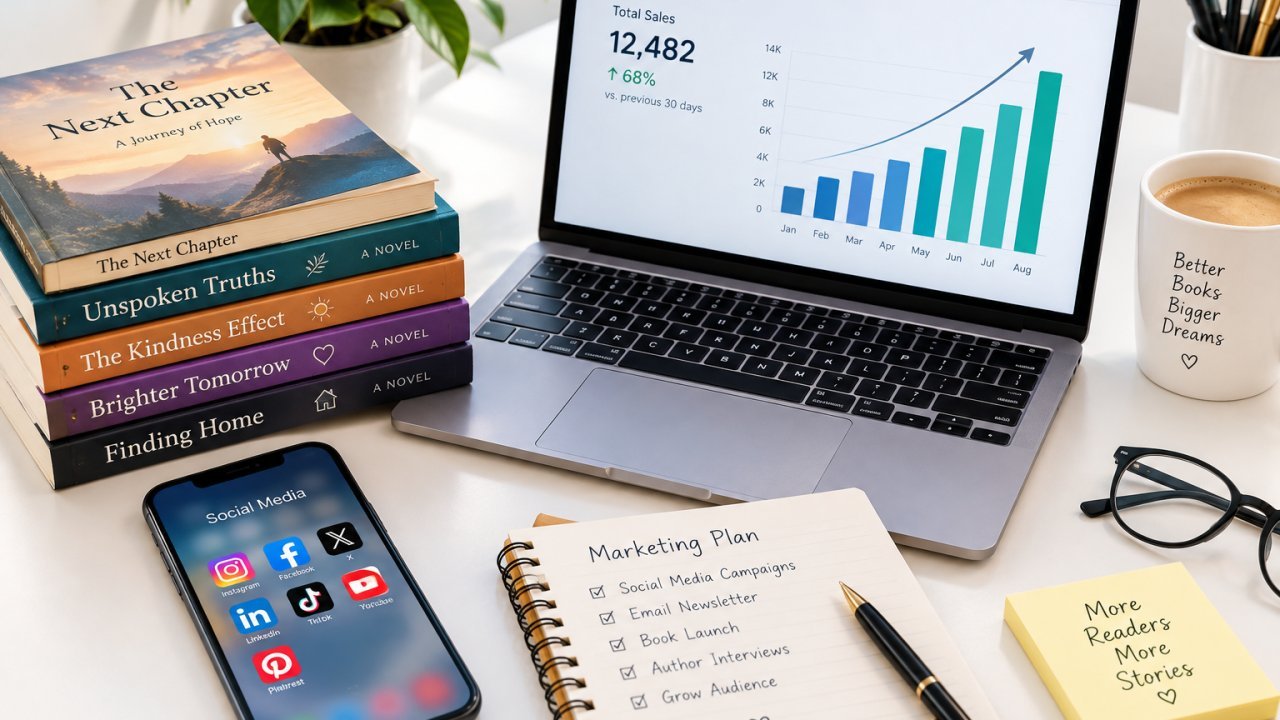
Marketing takes a finished book and turns it into sales, reviews and a reader base that buys your next title too. The process follows a simple logic. Strategy leads to a goal, and that goal breaks into three outcomes worth tracking separately, which are awareness, engagement and sales.
Amazon marketing matters more than almost any other channel, since Amazon accounts for the large majority of book purchases in most genres. That means optimized Amazon Marketing keywords, accurate category selection and a strong book description directly affect discoverability inside Amazon's own search engine, separate from Google.
Search engine optimization for your author website or book landing page builds organic, non paid traffic over time. A well optimized author site targeting your book's core topics can rank in Google search results long after a launch campaign ends, which compounds in a way paid ads never do.
Social media marketing across platforms like Instagram, TikTok and Facebook builds the audience relationships that convert into launch day sales. TikTok's BookTok community alone is credited with influencing an estimated 59 million print book sales in the US during 2025, generating roughly $760 million in retail revenue, so this channel is no longer optional for fiction authors chasing organic reach.
Meta Ads (Facebook and Instagram advertising) let you target readers by genre interest, comparable authors and demographics, making them one of the most controllable paid channels available to authors on a modest budget.
Influencer marketing through bookstagrammers, BookTokers and niche YouTube reviewers puts your book in front of an audience that already trusts the recommender, often driving stronger conversion than cold advertising.
Book reviews and PR outreach build the social proof that turns browsers into buyers. Submitting to NetGalley and Kirkus Reviews ahead of launch, running Goodreads giveaways and pitching book bloggers in your genre all generate the early reviews that make a book description look credible to a stranger.
Content marketing and email marketing work together through lead magnets such as a free short story or sample chapter that captures reader emails before launch. Building an email list ahead of time is one of the most reliable ways to guarantee a strong first week of sales, since Amazon's algorithm rewards early sales velocity with better visibility.
Post launch and backlist marketing keeps a book selling long after release week. Seasonal promotions, price drop campaigns, updated ad creative and cross promotion with newer titles all extend a book's earning life well past its launch window.
Which Metrics Actually Prove Your Book Is Working
Tracking the right numbers tells you whether your marketing spend and effort are actually converting, rather than just guessing based on gut feeling.
- Amazon Best Sellers Rank (BSR) shows relative sales velocity within a category, updated roughly hourly
- Click through rate (CTR) on ads and email campaigns shows how compelling your cover and copy actually are
- ACOS (Advertising Cost of Sale) on Amazon Ads or Meta Ads tells you whether ad spend is profitable
- Email open rate and list growth measure how engaged your reader base is over time
- Review count and average rating function as ongoing social proof that affects both conversion and algorithmic visibility
- Page reads (Kindle Unlimited) and units sold by format show which format and channel actually drives revenue
Reviewing these numbers weekly during launch and monthly afterward gives you a real feedback loop instead of relying on assumptions about what's working.
Common Mistakes That Slow Authors Down When Making a Book
Making a book takes long enough without avoidable mistakes adding months to the timeline. The most common one is skipping professional editing to save money, which almost always costs more later in the form of refunds, poor reviews or a full re edit. Close behind it is designing a cover based on personal taste rather than genre convention, which confuses readers about what kind of book they're looking at before they even read the description.
Other frequent missteps include publishing without a marketing plan already in place, choosing weak or overly broad Amazon categories that bury the book against impossible competition, ignoring metadata and keywords entirely and treating launch day as the finish line instead of the starting line for ongoing backlist marketing.
Why Authors Work With Olive Publishers
If you've read this far, you already understand that making a book well involves editing, design, formatting, metadata, distribution and marketing working together rather than as isolated tasks handled by five different freelancers who never talk to each other. That coordination gap is exactly where most self published projects lose quality or momentum.
Olive Publishers works with first time and previously self published authors who want that coordination handled by one team rather than pieced together on their own. The book publishing services cover editing, cover and interior design, formatting, ISBN and metadata setup plus distribution, while the marketing side builds out the Amazon, social media, email and PR strategy discussed above so a launch doesn't rely on hope alone.
If you're weighing cost against outcome, it helps to know what you're actually paying for. Reasonable questions to ask any publishing partner (Olive Publishers included) are who does the editing and what their background is, whether you retain full rights to your work, what the timeline looks like from manuscript to published book and what happens after launch day. A trustworthy partner answers all four clearly and never promises a guaranteed bestseller outcome, since no legitimate publisher can promise sales results. You can see current book marketing packages or simply talk to a publishing consultant about where your specific manuscript currently stands.
Start Making Your Book Today
You now have the full process of making a book laid out from first idea through post launch marketing. The next move is simply picking your starting point, whether that's finishing a draft, hiring an editor or getting a professional quote on the design and formatting stages. If you'd rather have an experienced team guide the whole process instead of managing five vendors yourself, reach out to Olive Publishers and describe where your manuscript currently stands.
Frequently Asked Questions About How to Create a Book
How to create a book raises a handful of questions that come up again and again, so here they are answered directly.
How long does it take to make a book?
Most first time authors complete the full process from finished manuscript to published book in three to six months, including editing, design, formatting and metadata setup. Writing the manuscript itself often takes an additional six months to two years depending on length and genre.
How much does it cost to make a book?
A DIY approach using free or low cost tools can run a few hundred dollars, mostly for a freelance editor. A fully managed, professionally produced book including editing, design, formatting and launch marketing commonly runs from around $1,500 up to $10,000 or more depending on scope.
Do I need an ISBN to make a book?
You need a separate ISBN for each edition (paperback, hardcover, ebook) if you want your book tracked by retailers, libraries and distributors under your own publishing name. Amazon KDP will assign a free ASIN or ISBN if you don't purchase your own, though buying your own ISBN gives you more control over the listed publisher name.
Can I make a book for free?
Yes, tools like Kindle Direct Publishing, Canva and Google Docs let you write, format and publish an ebook at no upfront cost. The tradeoff is your own time investment plus the risk of a less polished final product compared to professionally edited and designed books.
What software do I need to make my own book?
Word processors like Microsoft Word or Google Docs work for drafting. Dedicated formatting tools such as Vellum, Atticus or Affinity Publisher handle interior layout, while Canva or Adobe Photoshop cover cover design for authors without a hired designer.
How many pages does a book need to be?
There's no fixed minimum, though most print on demand services require at least 24 to 32 pages for binding purposes. Genre conventions matter more than a hard rule. Novels typically run 250 to 400 pages, while nonfiction business books often land shorter at 150 to 250 pages.
Should I self publish or go the traditional route?
Choose self publishing or hybrid publishing if speed, creative control and higher royalty percentages matter most to you. Choose traditional publishing if you want an advance, a literary agent's backing and national bookstore distribution, and you're comfortable with a longer timeline plus lower royalty rates.
How do I market a book after I publish it?
Build an email list before launch, submit for early reviews through NetGalley or Goodreads giveaways, run a coordinated social media and Amazon Ads push during launch week, then shift into ongoing backlist marketing through seasonal promotions and price adjustments.