On this page (16)
- How Discoverability on Amazon Works
- Metadata That Accurately Describes Your Book
- Writing a Book Description That Sells
- Categories and Comparable Books
- Pricing and Royalties Affect Your Ad Budget
- Amazon Ads and Budget Control
- Build a Page That Converts Interest Into Action
- External Marketing and Reader Communities
- Measure Performance Without Chasing a Single Rank
- Common Amazon Marketing Mistakes
- Comparison Table: Common Options
- Checklist Before You Approve Any Provider
- A Realistic Example
- Working With Olive Publishers
- Conclusion
- Frequently Asked Questions
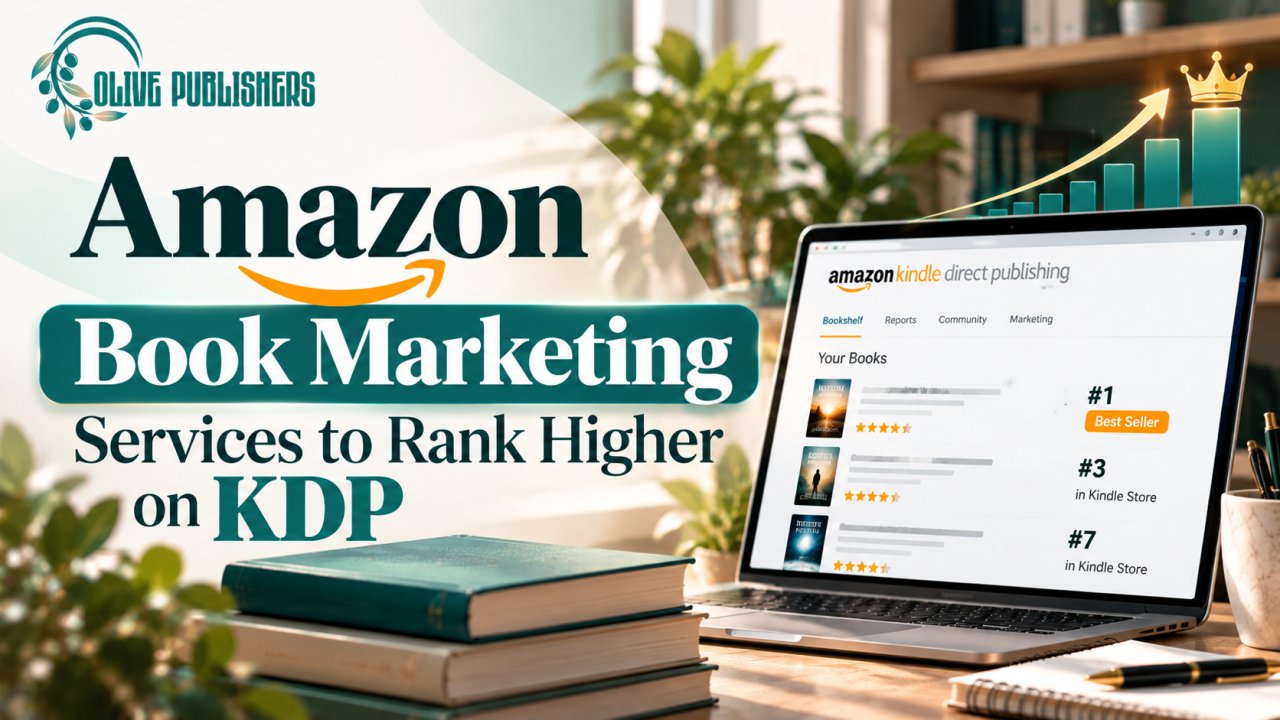
Amazon book marketing services help authors improve how readers discover and evaluate a title on Kindle Direct Publishing (KDP). The platform matters: Amazon handles over 50% of all new book unit sales in the United States and holds roughly 67% of the U.S. e-book market. With that much traffic, thousands of titles compete for the same shoppers every day.
Ranking is not controlled by one trick. It is shaped by relevance, reader behavior, sales activity, book-page quality, and competition. Sustainable marketing begins with an accurate product page and a clear plan.
Quick answer: Amazon book marketing services can support discoverability through relevant metadata, a compelling description, category research, advertising, and external promotion. No ethical provider can guarantee a specific ranking. Judge campaigns by relevant traffic, conversion, cost, and reader fit, not rank alone.
How Discoverability on Amazon Works
Amazon is both a retail store and a search engine. Readers search by topic, genre, author, problem, and title. Your product page, metadata, and ads decide whether your book appears and whether a shopper clicks.
Visibility alone does not create sales. A book with strong traffic but a weak page loses readers at the last step, which is why the work below follows a fixed order: listing first, ads second, promotion third. If you are still deciding how to publish, start with our guide on self-publishing for new authors.
Metadata That Accurately Describes Your Book
Metadata includes your title, subtitle, author name, description, keywords, and categories. KDP gives you 7 keyword slots per book, so each one should be a specific phrase readers actually type, not a generic single word.
KDP’s Metadata Guidelines warn that misleading metadata and keyword stuffing can cause listing problems. Use terms that match the book’s real content, such as “psychological thriller with unreliable narrator” instead of just “thriller.”
Writing a Book Description That Sells
Your description can run up to 4,000 characters (about 700 words), but shorter usually converts better. Aim for 150 to 300 words and put the strongest hook in the first two lines, because that is what shoppers see before expanding.
- Fiction: introduce the main character, conflict, stakes, and tone without spoiling key surprises.
- Nonfiction: state the reader’s problem, your approach, and the practical result.
KDP allows basic HTML (bold, italics, line breaks), so break text into short scannable blocks.
Categories and Comparable Books
Study books with a similar subject, audience, and format. Pick categories that are genuinely relevant, not just the least competitive ones. A mismatched category brings the wrong readers, which hurts conversion and reviews. Keep a log of the categories and keywords you tested so later decisions are based on data.
Pricing and Royalties Affect Your Ad Budget
Price decides how much you keep from each sale, so it should be set before you spend on ads.
- 70% royalty applies to e-books priced between $2.99 and $9.99.
- 35% royalty applies to prices outside that range.
- Paperbacks earn a 60% royalty minus printing costs.
At $9.99, a 70% royalty is about $6.99 before delivery fees. At $10.99, the 35% rate drops that to about $3.85, so a $1 price increase can nearly halve your earnings. If you plan to publish in print too, read about book print on demand.
Amazon Ads and Budget Control
Amazon Ads offers Sponsored Products and, for eligible authors, Sponsored Brands. Both generally use cost-per-click pricing, so you pay for clicks even without a sale.
- Set a daily budget you can afford to lose while testing.
- Define one goal per campaign (new release, backlist, or series).
- Review search terms weekly.
- Pause keywords that spend without orders.
Professional book marketing services usually manage this testing so authors do not burn budget on irrelevant clicks.
Build a Page That Converts Interest Into Action
Shoppers scan the cover, title, description, reviews, and sample in seconds. Before running ads, check:
- The cover is readable at thumbnail size
- The description is proofread
- The correct edition and price are selected
- The first pages deliver on the promise
Cover quality matters most here. See book cover design services cost for realistic budgets, and what to put on the back cover of a book for print editions. A missing or wrong ISBN also causes listing issues, so review how to get an ISBN.
External Marketing and Reader Communities
Amazon traffic improves when readers arrive from outside too. Useful channels include an author website, newsletter, podcasts, interviews, launch events, and social posts. Choose channels where your readers already spend time.
Never buy fake reviews or offer incentives for positive ones. Honest promotion builds long-term trust, and manipulation can get accounts penalized. For more on what actually works, read what book marketing services actually help authors sell more books.
Measure Performance Without Chasing a Single Rank
Track impressions, clicks, click-through rate, cost per click, orders, conversion rate, and advertising cost of sales (ACOS). Rank changes daily, so treat it as one signal. A new release and a backlist title need different goals and different benchmarks.
Common Amazon Marketing Mistakes
- Targeting unrelated keywords
- Spending before the product page is ready
- Running many campaigns without clear goals
- Changing several variables at once
- Expecting immediate results
- Relying on a single launch burst with no long-term reader path
Keep tests small, record every change, and learn from the data.
Comparison Table: Common Options
| Option | Best suited for | What to confirm |
|---|---|---|
| Metadata improvement | Relevant organic discovery | Accuracy and current KDP rules |
| Sponsored ads | Testing paid visibility | Budget, clicks, conversions |
| External promotion | Audience development | Reader fit and tracking |
| Description and cover refresh | Improving conversion | Thumbnail clarity, copy quality |
Checklist Before You Approve Any Provider
- Confirm audience and main goal
- Agree on deliverables, timeline, revision rounds, and ownership
- Check current KDP and Amazon Ads policies, not old advice
- Keep approvals in writing
- Review final work as a reader would see it
- Avoid anyone promising guaranteed rankings or sales
A Realistic Example
An author has a live book page and receives clicks but few purchases. Instead of raising ad spend, they review search-term relevance, cover readability, description clarity, and sample pages. They fix the description, then run a small campaign on keywords that match the book. Results are reviewed over several weeks, not judged on one day’s rank.
Working With Olive Publishers
Olive Publishers is a New York based author services company supporting writing, editing, design, publishing, and marketing. Before starting, share your genre, current listing, audience, goals, budget, and assets. Ask what work will be completed, how progress is reported, and which outcomes are measurable.
If you are comparing agencies, our guide on how to choose the right book publishers agency in New York helps. Authors in Manhattan can also explore Olive Publishers Manhattan. If your book is not finished yet, see ebook writing services and ebook formatting service.
Conclusion
Amazon book marketing services work best with a clear brief, realistic expectations, and attention to the reader’s experience. Fix metadata, description, price, and cover first, then test ads in small steps, and measure results against your goal instead of daily rank. To talk through your book and next steps, contact Olive Publishers.
Frequently Asked Questions
Can Amazon book marketing services guarantee a KDP ranking?
No reputable service can. Visibility depends on competition, shopper behavior, and relevance. A provider can improve your listing, manage campaigns, and report results, but should never promise a fixed rank or guaranteed sales.
What matters most for Amazon book discoverability?
Relevant metadata, an accurate description, a clear cover, appropriate categories, and a managed promotional plan. Ads bring shoppers, but the product page must convince them.
Are Amazon Ads pay per click?
Sponsored Products and Sponsored Brands generally use cost-per-click pricing. Set budgets, monitor clicks and orders, and check current availability in Amazon Ads guidance.
How should I choose KDP keywords?
Use all 7 slots with phrases describing your topic, genre, audience, or reader need. Avoid unrelated terms and stuffing.
How long does Amazon book marketing take to work?
It varies by book, competition, budget, and page quality. Some changes affect traffic quickly, while others need repeated testing. Set a review schedule and measure meaningful outcomes.
Do reviews improve a book’s ranking?
Reviews help shoppers decide, but fake or incentivized reviews break Amazon’s rules. Only honest reviews are safe.
Should I run ads before my book page is ready?
No. Fix the cover, description, metadata, and price first, then test ads with a controlled budget.
What should a marketing report include?
Spend, impressions, clicks, CTR, orders, conversion, actions taken, and what will change next, not just rank snapshots.
Related services: Amazon book marketing services | book publishing services | self-publishing support | book cover design | ebook formatting