On this page (32)
- Quick Answer
- Why Self-Publish a Children's Book?
- How to Self-Publish a Children's Book: 10 Steps
- Step 1: Define the Age Range and Purpose
- Step 2: Write and Edit the Manuscript
- Step 3: Build a Storyboard
- Step 4: Brief and Hire an Illustrator
- Step 5: Design the Layout and Page Turns
- Step 6: Design a Cover That Sells
- Step 7: Choose Format, Trim Size, and Printing
- Step 8: Order a Physical Proof
- Step 9: Prepare Metadata and Your ISBN
- Step 10: Publish, Distribute, and Launch
- Children's Book Self-Publishing Costs
- How to Market a Self-Published Children's Book
- Before launch:
- At and after launch:
- Common Mistakes First-Time Children's Book Authors Make
- Final Quality Checklist
- How Long Does It Take?
- When to Hire Professional Help
- How Olive Publishers Can Help
- Final Takeaway
- Frequently Asked Questions
- Can I self-publish a children's book?
- How much does it cost to self-publish a children's book?
- How many pages should a children's book have?
- Do I need an illustrator?
- Should I choose paperback or hardcover?
- How do I market a children's book?
- Why is a physical proof important?
- Can a publishing company help with children's books?
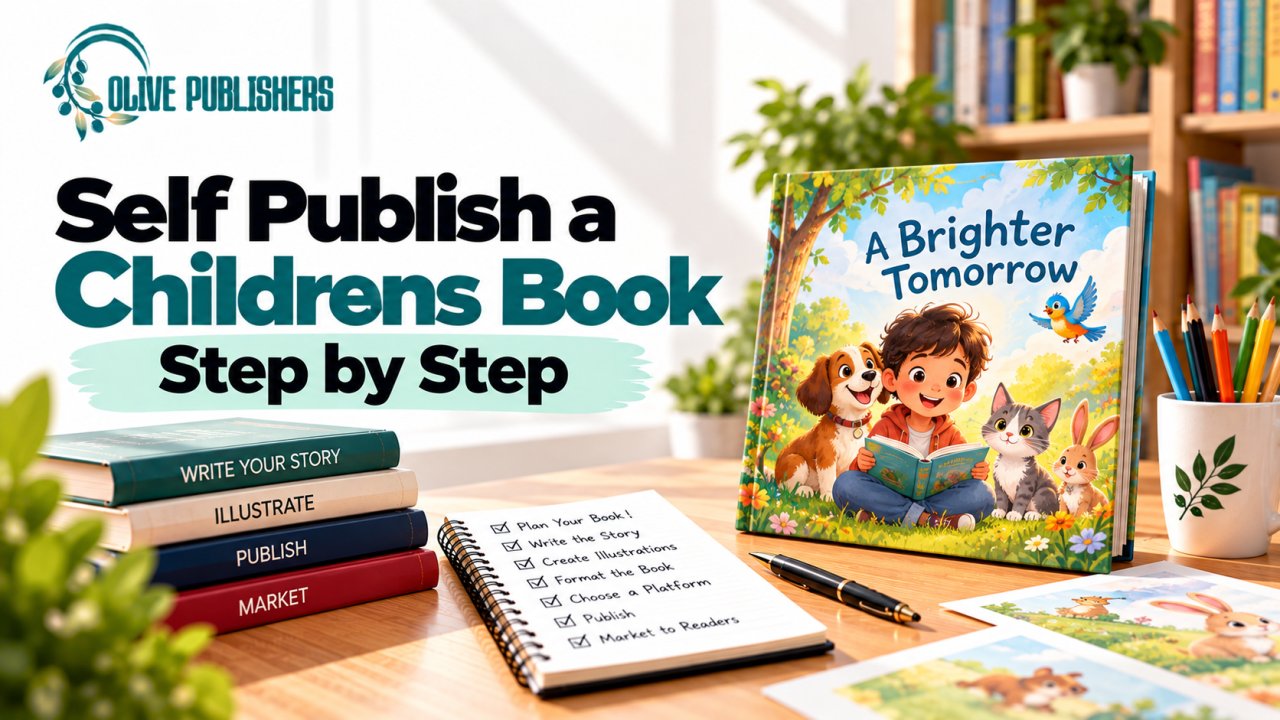
To self-publish a children's book, you need more than a good story. You need a defined age range, text and illustrations planned together, a print format that suits the reading experience, a physical proof, and marketing aimed at the adults who actually buy the book. This guide walks through each step in order.
Quick Answer
- Define the reader's age and the book's purpose first.
- Plan text and illustrations together, page by page.
- Choose trim size, paper, binding, and color around how the book will be used.
- Order a physical proof before you approve final files.
- Market to parents, grandparents, teachers, librarians, and gift buyers, not only to children.
Why Self-Publish a Children's Book?
Self-publishing gives you control over the story, characters, visual style, schedule, and publishing decisions. That matters when you have a specific audience, a distinctive illustration style, or a character you plan to build into a series.
The opportunity is real, and so is the competition:
- US publishers earned $5.4 billion from children's and young adult fiction in 2025, up 0.9%, plus $1.0 billion from children's and young adult nonfiction, up 0.3%.
- Self-published authors registered 401,716 juvenile nonfiction titles and 265,615 juvenile fiction titles with ISBNs in 2025.
- In total, more than 3.5 million self-published titles with ISBNs appeared in the US in 2025, up 38.7% in one year.
So demand is steady, but the shelf is crowded. A children's book also serves two audiences at once: the child who reads or listens, and the adult who decides whether to buy. The book has to work for both.
If this is your first project, our self-publishing guide for first-time authors covers the wider process.
How to Self-Publish a Children's Book: 10 Steps
Step 1: Define the Age Range and Purpose
Decide the age range before you finish the manuscript. It controls vocabulary, sentence length, illustration detail, type size, page count, and how you describe the book later. Treat it as a production guide, not just a marketing label.
|
Format |
Typical age |
Typical length |
|---|---|---|
|
Board book |
0 to 3 |
Under 300 words, 12 to 24 pages |
|
Picture book |
2 to 8 |
500 to 1,000 words, usually 32 pages |
|
Early reader |
5 to 9 |
A few hundred to 2,500 words |
|
Chapter book |
6 to 10 |
5,000 to 20,000 words |
These ranges are typical, not rules. A story's needs should decide its length.
Also think about the adult buyer. A parent may look for emotional or educational value, a teacher for classroom fit, and a gift buyer for presentation.
Step 2: Write and Edit the Manuscript
Read it aloud as you revise. Young readers experience a book through rhythm and sound, so awkward wording, missing transitions, and pacing problems show up quickly when spoken. Finish major editing before final layout, because changing text after artwork is done can mean redesigning finished pages.
If you have an idea but not the time to write it, you can hire a ghostwriter for children's books and keep creative approval.
Step 3: Build a Storyboard
A storyboard maps words and pictures before any final art exists. For every page or spread, note the text, the key visual action, the characters present, the setting, and the page turn.
Storyboarding exposes pacing problems early. One page may carry too much text for its picture, while another may have too little going on. Moving scenes at this stage costs far less than changing finished artwork. Keep one approved version so the editor and illustrator work from the same structure.
A 32-page picture book usually needs roughly 14 to 16 spreads of artwork once front matter is accounted for, so a storyboard also tells you how big the illustration job really is.
Step 4: Brief and Hire an Illustrator
If the book depends on original art, write a visual brief before work starts. Include character descriptions, settings, color direction, age range, mood references, the number of illustrations, and the file formats you need.
Agree in writing on revision rounds, what counts as a revision, and, most importantly, commercial usage rights and ownership. Character consistency matters across every page: proportions, clothing, facial features, and colors should stay recognizable unless the story changes them.
Step 5: Design the Layout and Page Turns
Illustration and layout work as one system. Art can carry part of the story while the text carries another. If text sits too close to an important visual element, the page becomes hard to read.
Plan page turns on purpose. A reveal, a surprise, or a question lands harder when the answer appears after the turn.
Step 6: Design a Cover That Sells
The cover should communicate genre, audience, tone, and story promise at a glance, including at thumbnail size on a retailer page. It is part of the product, not an afterthought. For budgeting, see our guide to book cover design services cost.
Step 7: Choose Format, Trim Size, and Printing
Choose specifications around who will use the book and how.
- Keepsake picture book: a premium hardcover or a square paperback.
- Classroom or activity book: a more economical, durable format. For activity pages, see how to publish a coloring book.
- Digital edition: plan it separately. A picture book often needs a fixed-layout ebook, while a text-heavy chapter book can use a flexible layout. Our ebook formatting service page explains the difference.
Some practical specs to know before you commission art:
- Square 8.5 x 8.5 inch trim is common for picture books, and portrait 8 x 10 inches is another popular choice.
- Amazon KDP paperbacks need at least 24 pages.
- Illustrations should be 300 DPI at the final print size, not screen size.
- Full-color interiors cost more to print than black-and-white, so set your price with print cost in mind.
Print on demand avoids inventory costs, while a larger print run makes sense when demand already exists. We explain how it works in our guide to book print on demand. Always confirm the current file requirements of your printer before you finalize files.
Step 8: Order a Physical Proof
A screen cannot show you how color prints, whether text sits too close to the gutter, or whether an image is cropped. Order a proof and check every spread in sequence:
- Character consistency across the whole book
- Text readability and margins
- Image placement and bleed
- Color accuracy
- Page turn logic
- Match between words and artwork
Then read the book aloud one final time with the proof in hand.
Step 9: Prepare Metadata and Your ISBN
The title, description, categories, age range, keywords, and author details should all signal the same audience. Write the description in plain language: what the book is about, who it is for, and why it is useful or enjoyable. Avoid claims the book cannot support. If you are unsure how identifiers work, read how to get an ISBN.
Step 10: Publish, Distribute, and Launch
Match your sales channels to your audience. Online retail gives broad reach, while schools, libraries, events, gift shops, and community groups can deliver targeted sales. Check that your publishing workflow supports the channels you want, because a setup built only for one retailer may not suit an author pursuing schools or independent bookstores.
Children's Book Self-Publishing Costs
Children's books usually cost more to produce than text-only books because illustration and color printing add work. The main cost areas are:
- Editing and proofreading
- Illustration (often the largest line item)
- Cover design
- Interior layout
- Printing and proof copies
- ISBN, metadata, and distribution
- Marketing
Build the budget before you commission final artwork. Changing completed spreads is expensive, so settle page count and storyboard first. Include proofing and marketing in the plan from the start. If you are weighing packages against hiring separately, our overview of self-publishing packages shows what a package can and cannot include.
How to Market a Self-Published Children's Book
Marketing targets the adults who buy or influence the purchase: parents, grandparents, teachers, librarians, homeschool groups, and gift buyers.
Before launch:
- Share the concept, character development, and illustration process without revealing everything.
- Set up an author website or landing page and collect interested readers.
- Prepare retailer copy, sample pages, social content, and review outreach.
- Build assets from the approved final edition, never from a draft that may still change.
At and after launch:
- Use read-aloud excerpts, behind-the-scenes posts, and educational angles on social media.
- Use email for launch announcements.
- Work with influencers or community groups only when the audience fit is genuine.
- Focus on reviews, retailer page optimization, school and library outreach, seasonal campaigns, and backlist promotion.
Trust matters because adults decide whether a book is right for a child. Clear age information, accurate descriptions, readable previews, honest reviews, and transparent author details reduce doubt. For help building a launch plan, see our book marketing services guide.
Common Mistakes First-Time Children's Book Authors Make
- Choosing the age range too late
- Writing too much text for the page count
- Commissioning illustrations without a storyboard
- Letting character designs drift between pages
- Ignoring trim size until artwork is finished
- Treating the cover as an afterthought
- Approving files without a physical proof
- Assuming publication creates discovery on its own
Final Quality Checklist
- Age range, title, cover, interior, description, price, and distribution details all tell the same story.
- Major editing is finished before final formatting.
- Format, trim size, paper, binding, and image requirements are confirmed with the printer.
- Metadata is ready.
- A physical proof has been reviewed.
- Source files are stored separately from final production files.
- Marketing is ready before launch.
Once you approve the final edition, archive the approved files with a clear version name. That protects you when you produce a later edition or reprint.
How Long Does It Take?
A children's book takes longer than a text-only book because writing, editing, illustration, layout, proofing, and production are tightly linked. Plan the schedule around approvals, not calendar days. Leave enough time for illustration revisions and keep the final proof before the public launch. A small delay in production is far easier to handle than a major visual problem found after release.
When to Hire Professional Help
Professional support helps most when you are comfortable writing but less experienced with illustration direction, interior production, printing, or distribution. It adds specialist knowledge without taking away your creative control. Before hiring, ask for samples from the same type of book, because a picture book is a different job from a novel cover or a corporate design. Get a written scope covering deliverables, revisions, ownership, timeline, and price.
How Olive Publishers Can Help
Olive Publishers supports authors across writing, editing, formatting, design, publishing, and marketing, so one team can coordinate several stages of a children's book project. Confirm the exact deliverables, ownership terms, revisions, timeline, and pricing in writing before you start. You can learn more about our book publishing services in New York.
Final Takeaway
A strong children's book combines story, illustration, production, and marketing. With more than 4 million new US titles in 2025, quality and clear audience positioning matter from the first concept through launch. Define your reader, storyboard before you commission art, proof the printed book, and market to the adults who buy it.
Frequently Asked Questions
Can I self-publish a children's book?
Yes. You can manage editing, illustration, formatting, printing, distribution, and marketing yourself, or hire specialists for selected stages.
How much does it cost to self-publish a children's book?
Costs vary widely. Illustration, color printing, design, proofing, distribution, and marketing all affect the total, and illustration is usually the biggest part. Get itemized quotes before you commit.
How many pages should a children's book have?
Most picture books run 32 pages, with 500 to 1,000 words. Board books are shorter, and early readers and chapter books are longer. KDP paperbacks require at least 24 pages.
Do I need an illustrator?
If the book depends on original art, yes: either you create it or a professional does. Make sure you hold commercial rights to every image in writing.
Should I choose paperback or hardcover?
It depends on audience, budget, durability, and sales channel. Hardcovers suit keepsake and gift books, while paperbacks suit lower prices and classroom use. Both can work when matched to the project.
How do I market a children's book?
Reach the adults who buy it through your website, social content, email, school and library outreach, community groups, and genuine reviews. Start before launch.
Why is a physical proof important?
It reveals color, cropping, margin, and page turn problems that are hard to judge on a screen.
Can a publishing company help with children's books?
Yes. A publishing team can coordinate editing, illustration, formatting, publishing, distribution, and marketing. Confirm the exact scope before you pay.